SeamlessChex
Took over a prototype stuck after two years of outside development, re-architected it on AWS in six months, then stayed the exclusive engineering partner for eleven years.
Overview
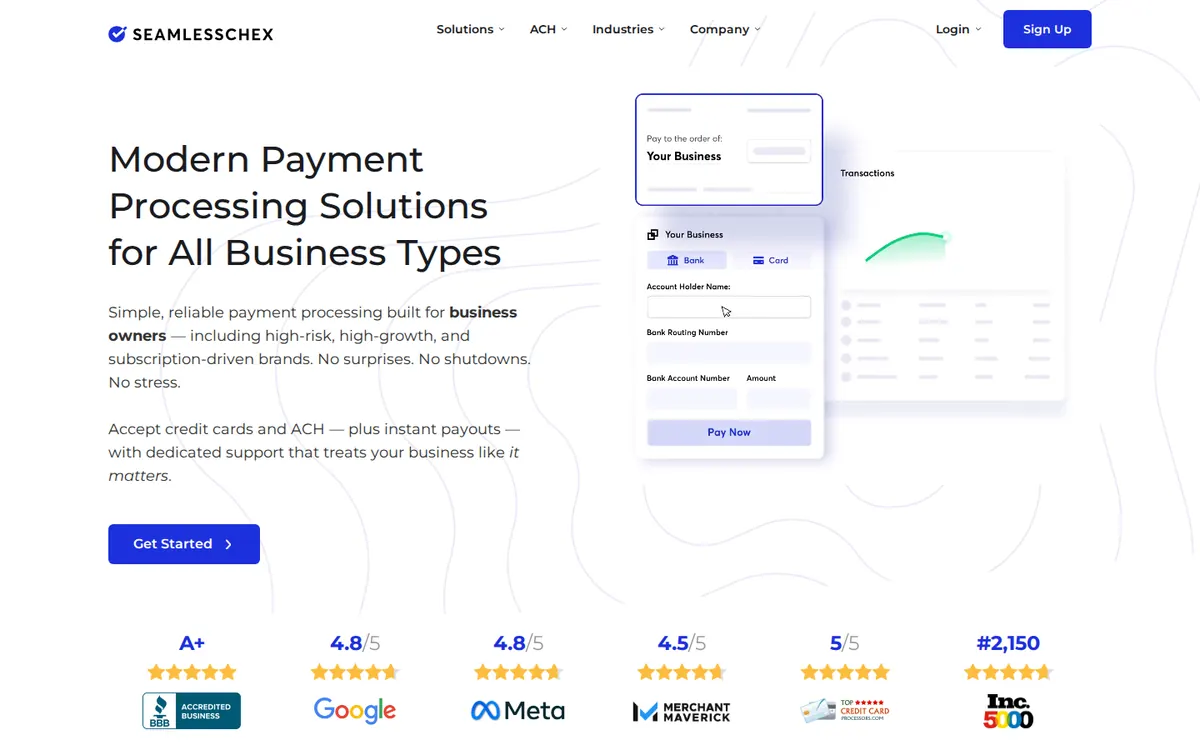
SeamlessChex processes eCheck and ACH payments for US businesses, and Paynote is its bank-transfer product. I took over a platform prototype that had been stuck after two years of outside development, re-architected it on AWS in six months, and then stayed the exclusive engineering partner for eleven years: the server and portals, the partner API, the WooCommerce plugins and, most recently, the marketing site.
The core is one Laravel codebase behind the merchant portal, the admin back office, a public REST API with a sandbox, and background jobs. It covers the whole check lifecycle: checks entered online, in bulk or through payment links, verification, batch closing, printing and electronic deposit files. Plaid and Dwolla handle verified bank accounts and ACH transfers, Stripe bills merchants for their plans, and a partner program tracks agents, deals and commissions.
Around that core sit the parts other businesses touch directly: a versioned partner API (v1/v2) that other products embed, a Checkout.js payment widget, and three WooCommerce payment plugins in the WordPress.org directory. The portal moved from AngularJS to Angular with NgRx and later took on React micro-frontends. In 2026 the marketing site moved from Webflow to Astro on Cloudflare Pages.
Eleven years in, the platform is not one application but thirteen repositories, and in September 2026 every one of them still takes commits. The two products have their own backends - eCheck on Laravel 8, Seamless ACH on PHP 8.2 with Laravel 11 and 12 - and their own Angular 14 portals, with a React 19 and Vite 7 dashboard as the single front door into both and a Next.js 16 portal handling applications and onboarding. Around them sit Python microservices on Lambda deployed by CDK, internal automation written in Python and Go, an integration hub carrying the documentation, SDKs and a hosted demo behind CloudFront, the marketing site and blog on Astro 7 and Cloudflare Pages, the WooCommerce plugin, and two Playwright suites - one per product - that exercise the payment flows end to end.
What was built
- A Laravel back end on PHP 7.4 that serves the merchant portal, admin back office, public API, sandbox, demo and scheduled jobs from one codebase, each shipped as its own container.
- Check processing end to end: single, bulk and recurring checks, payment and bank-authorization links, batch closing, check printing to PDF, and X9.37 image cash letter files carrying front and back check images for deposit.
- Bank connectivity: Plaid Link with re-authentication, Dwolla business customers, funding sources and ACH transfers, instant and manual verification, GIACT account checks, and a bank directory imported from the Federal Reserve FedACH file.
- A partner API in two versions with API-key access, per-application audit logs, webhooks and separate live and test credentials, documented as an OpenAPI reference and backed by a sandbox environment.
- Checkout.js, an embeddable payment widget shown as an iframe or lightbox, supporting one-time and recurring payments on the merchant's own site.
- Merchant portals for SeamlessChex and Paynote: onboarding and verification wizards, transactions, payment links, invoices, recurring billing, funding sources, webhooks, API keys, reports, and partner and agent commission views.
- Three WooCommerce gateways on WordPress.org: SeamlessChex eCheck Payments (listed since 2020), Paynote, and its 2026 successor Seamless ACH with Plaid-verified payments, recurring billing, authorization-only capture and refunds.
- The marketing site rebuilt from Webflow in Astro, Tailwind and MDX on Cloudflare Pages, with industry landing pages, the blog, imported legacy redirects and lead forms handled by Pages Functions.
- A single sign-in dashboard on React 19 and Vite 7 that opens into both products, so a merchant using eCheck and ACH has one front door instead of two.
- An application and onboarding portal on Next.js 16, where a prospective merchant's paperwork and approval state live.
- Python microservices on AWS Lambda, deployed by CDK, for the supporting APIs and side effects around the core platform.
- Internal automation services in Python and Go on Lambda for the operations and security side of running a regulated payments platform.
- An integration hub for the people who build on the API: documentation, SDKs and a hosted demo, served through CloudFront.
- Two end-to-end Playwright suites, one per product, so a release is checked against the payment flows rather than against unit tests alone.
Stack
Frontend
- Angular 14 + NgRx
- Merchant portals for both products, grown out of the original AngularJS client
- React 19 + Vite 7
- The shared dashboard that signs a merchant into either product
- Next.js 16
- Application and onboarding portal
- Astro 7 + Tailwind
- Marketing site and blog on Cloudflare Pages
- AngularJS 1.5
- The client the platform started on, before the Angular rebuild
Backend
- PHP 8.2 / Laravel 11-12
- Seamless ACH backend
- PHP / Laravel 8
- eCheck backend, the core the platform was re-architected around
- Python on AWS Lambda
- Supporting microservices and side effects, deployed with CDK
- Go
- Part of the internal automation services
- Laravel jobs + Supervisor
- Background processing for batches, files and notifications
- Cloudflare Pages Functions
- Server-side endpoints for the marketing site
Data
- MySQL 8
- Primary store for merchants, checks, batches, subscriptions and API logs, on Amazon RDS in production.
- Redis 6
- Runs next to MySQL in the Docker Compose development environment for the server.
Infrastructure & DevOps
- AWS CDK
- Defines separate ECS Fargate services for portal, API, jobs, sandbox, demo and dev behind load balancers.
- ECS Fargate + Docker
- One image per role from the same codebase, with CPU-based autoscaling configured per service.
- S3 + CloudFront
- Host the Angular portals for production, dev and demo, with cache invalidation on each deploy.
- SES + SNS
- Transactional email, with bounce and delivery notifications fed back into the platform's email records.
- CircleCI
- Builds server images to ECR and deploys to ECS; builds the portals and runs Cypress tests.
- GitHub Actions
- Branch-based deploys of the portal and React bundle, and of the Astro site to Cloudflare Pages.
Integrations & Payments
- Plaid
- Bank account linking and instant verification in the portals, the API flows and the WooCommerce plugins.
- Dwolla
- Business customer onboarding, funding sources and ACH transfers behind Paynote.
- Stripe
- Merchant subscription plans, charges, coupons and invoices through Laravel Cashier.
- GIACT
- Bank account verification service whose response codes are recorded per check and per merchant.
- Checkout.js
- Embeddable eCheck payment widget with one-time and recurring options, used by the eCheck plugin.
- HubSpot + Zoho CRM
- Merchant deals, pipeline stages and notes pushed to HubSpot; merchant data synced to Zoho CRM on a schedule.
- DocuSign
- Merchant agreements sent as envelopes generated from DocuSign templates.
- Twilio
- SMS messages to merchants, such as phone verification codes.
- Google Ads API
- Offline conversion uploads by click ID, plus campaign lookups that attribute signups to ad campaigns.
- Klaviyo + Mailchimp
- Marketing audience profiles updated as merchants move through onboarding steps.
- NeverBounce + MaxMind
- Email address validation and fraud screening services integrated into the platform.
CMS & Commerce
- WooCommerce plugins
- SeamlessChex eCheck Payments, Paynote and Seamless ACH gateways, published in the WordPress.org plugin directory.
- WooCommerce Blocks
- Block-based checkout support alongside classic checkout in the eCheck and Seamless ACH gateways.
Tooling & QA
- Playwright
- Two end-to-end suites, one per product, exercising the payment flows
- PHPUnit
- Backend test suites
- Cypress
- Portal tests from the Angular era
- OpenAPI + ReDoc
- The public API contract and its rendered documentation
Engineering highlights
Took over a prototype stuck after two years of outside development and re-architected it on AWS in six months; the engagement then ran for eleven years as the exclusive engineering partner.
Split one Laravel codebase into separate Fargate services per role (portal, partner API, background jobs, sandbox, demo, dev), defined in AWS CDK, so each can be sized, scaled and deployed on its own.
Modernized the front end in stages: AngularJS, then Angular with NgRx, then React micro-frontends loaded into the Angular portal through Module Federation, with the older portal kept in service alongside its successor.
Retired the Paynote plugin in 2026 without stranding stores: Seamless ACH imports the previous gateway's settings on activation and keeps existing orders working, including status sync and refunds.
Two products, one front door: rather than making merchants learn two portals, the newest piece is a shared dashboard that signs them into eCheck or ACH from one place - the kind of consolidation only an engineering partner still there after nine years gets to do.
Each product carries its own end-to-end suite. In payments a release is not judged by unit tests; it is judged by whether money still moves.