SINGER22
Built and ran the custom PHP and JavaScript platform behind SINGER22, a 10,000+ SKU fashion retailer: storefront, ERP and warehouse integration, apps and marketing tools, then the move to Shopify in March 2021 with custom integrations.
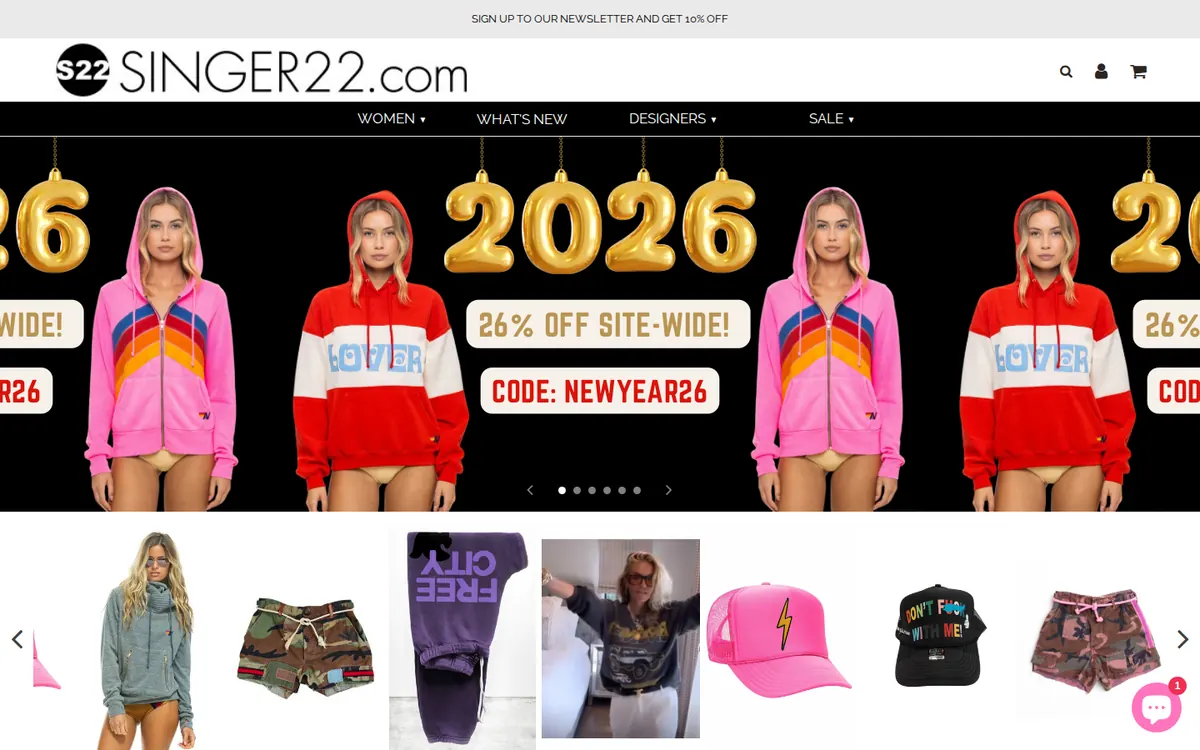
Overview
SINGER22 was a contemporary fashion retailer led by CEO Jon Singer, with retail stores in Great Neck and East Hills, New York, and a 10,000+ SKU online store at singer22.com. Data Subsystems started in the back office in 2010, installing its ERP system and wiring it into the retailer's Yahoo! Merchant Solutions store - the platform the shop was still running that September. It then built and ran the custom PHP platform - Zend on the server, JavaScript in the browser - that carried singer22.com for more than a decade.
The archive dates both ends of that decade. On 28 September 2010 singer22.com is still the Yahoo! store; by 14 November 2010 it is the in-house platform - assets served from singer22.net/static, jQuery 1.4.2, and routes in module/controller/action shape (/customer/account/login, /shopping-cart/cart/show) that match the Zend framework it was written on. The men's store had launched on the same platform that October. Every archived snapshot from then until 2 March 2021 is that platform: ten years and four months in production, through a men's store, an international setup, mobile apps and a record traffic spike. The next snapshot, on 11 March 2021, is Shopify - and the theme asset stamped into its og:image dates to 27 February 2021, so the cutover happened in the first days of March, with the theme prepared in the fortnight before it.
The platform grew with the business: a men's store in 2010, an international setup with servers in several countries managed from one central database, iPhone and Android apps, and marketing integrations with Constant Contact, Pinterest and Facebook. When an E! News segment about SINGER22 brought record traffic in 2011, content offloaded to Akamai kept the store browsable and taking orders. Around 2021 the store moved to Shopify, with custom integrations maintained afterwards.
The centre of gravity was not the storefront but the back office. The admin behind it was where the shop's books were kept, and the same system was used in the retail stores, so one set of records covered the website and the counter instead of two that had to be reconciled. Everything the business ran on - purchasing, receiving, inventory, orders, POS sales - lived there.
The fashion business has since closed. The same owner rebuilt the Shopify store as 22sGems, a fine-mineral brand, and singer22.com now redirects there; that relaunch has its own case study.
What was built
- Custom PHP and JavaScript storefront for singer22.com: category and designer catalogues, What's New by arrival date, celebrity picks, pre-orders, tiered sale sections, VIP login, favorites and wish lists.
- ERP integration with the earlier Yahoo! Merchant Solutions store: two-way sync of orders, products, variations, categories, tracking numbers and charges through the Yahoo! Orders and Payments APIs, with UPS, FedEx and USPS shipping.
- Wireless warehouse management: barcode handhelds, Zebra label printing over the network, a 3D warehouse modeler for bin locations, purchasing and receiving, and in-store POS sales feeding one inventory across two warehouses and two stores.
- A dedicated men's shopping site launched in 2010 on the same e-commerce platform, and an international setup run from one central database.
- Marketing integrations: Constant Contact email automation with back-in-stock alerts for the VIP list, a Pin it button on every product with an internal pinboard, and a Facebook sweepstakes app that drew random winners and emailed store-credit codes.
- iPhone and Android shopping apps, promoted on the site with 10% off the first in-app purchase; the Android app is published under Data Subsystems' own package name.
- Shopify migration for the 10,000+ SKU catalogue with custom integrations, on a PLAK-based theme with Boost product filtering and instant search.
- A back-office admin that doubled as the store's accounting system and was used by staff in the retail locations as well as online, so web and counter ran on one set of records.
- Shopify apps to close the gaps the platform left after the migration: private apps for needs specific to this store, public apps where the same gap existed for other merchants - multi-supplier purchasing inventory among them.
Stack
Frontend
- JavaScript, jQuery
- Client side of the custom singer22.com storefront, with jQuery 3 and jQuery UI in the 2020 site
- iOS and Android apps
- SINGER22 shopping apps listed on the App Store and Google Play
Backend
- PHP / Zend Framework
- Server side of the custom e-commerce platform and its back office, behind singer22.com for over a decade
Infrastructure & DevOps
- Akamai
- Offloaded content so a 2011 E! News traffic spike left the origin servers unaffected
- Barcode WMS hardware
- Wireless Windows Mobile handhelds and networked Zebra label printers in the warehouses
Integrations & Payments
- Yahoo! Orders and Payments APIs
- Two-way sync between the ERP and the hosted Yahoo! store, including bulk payment processing
- UPS, FedEx, USPS
- Carrier integration for labels, tracking numbers and shipping confirmations
- Constant Contact API
- Automated mailers, contact list management and back-in-stock notifications
- Pinterest, Facebook
- Pin it buttons on every product and a sweepstakes app for Facebook fans
- Shopify Admin API
- Custom integrations for the 10,000+ SKU Shopify migration and upkeep
- Klaviyo
- On-site email capture on the SINGER22 Shopify store
- Google Ads
- Google Ads know-how praised in Jon Singer's LinkedIn recommendation of the company
CMS & Commerce
- Custom e-commerce platform
- Catalogue, cart, VIP accounts, wish lists and promotions for singer22.com
- DataSub ERP
- Order processing, CRM, purchasing, warehouse and touchscreen POS modules for stores, warehouses and web store
- Yahoo! Merchant Solutions
- The hosted store the ERP synchronized with in 2010
- Shopify
- The SINGER22 storefront from about 2021, after the move off the custom platform
- PLAK theme
- PLAK-based Shopify theme for the SINGER22 catalogue
- Boost Filter & Search
- Product filtering and instant search on the SINGER22 Shopify catalogue
- Shopify apps, private and public
- What Shopify did not cover was added as apps; the ones other merchants could use were published
Tooling & QA
- Automated tests
- Test suites in the Shopify integration codebase
Engineering highlights
Ten years and four months is the real test of a custom platform: singer22.com ran on the in-house stack from the autumn of 2010 until the first week of March 2021, absorbing a men's store, an international setup, mobile apps and a national television traffic spike before the catalogue moved to Shopify.
The 2010 ERP integration with Yahoo! Merchant Solutions went deep enough that staff no longer needed the Yahoo! back end: products edited in the ERP went live automatically, sold-out items came off the site, and shipping confirmations were uploaded to charge orders.
During the 2011 E! News segment about SINGER22 the store saw record traffic; with content offloaded to Akamai the origin servers were not affected and visitors kept placing orders.
One system covered two businesses that usually run apart: the website and the retail floor shared the same inventory, the same purchasing and the same books, which is why the counter could sell what the site had just reserved.
After the Shopify move the missing pieces were built as apps rather than as patched theme code, and the ones that were not specific to this store were published for other merchants to use.