Relevant e-Discovery
Public site for an AI-assisted e-discovery review platform: a raw litigation collection - mailboxes, scans, phones, recordings - turned into one searchable, issue-coded, court-ready record.
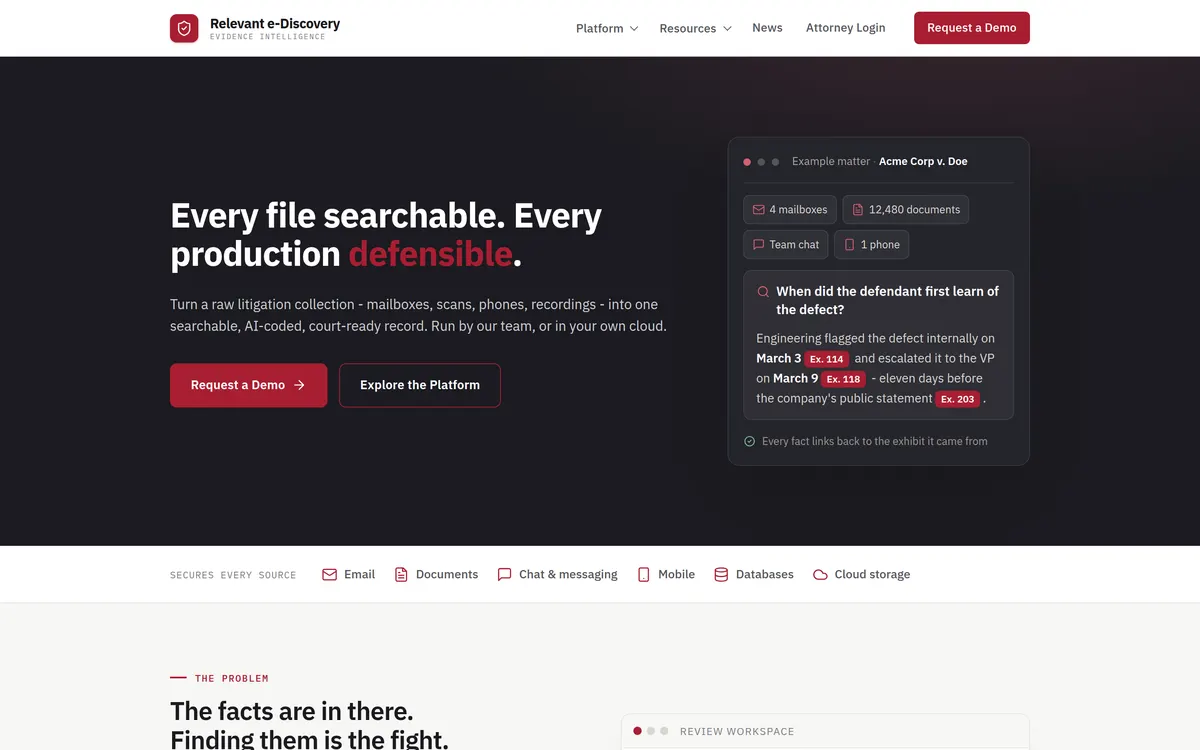
Overview
Relevant e-Discovery sells an AI-assisted review platform for litigation together with the team that runs it: a raw collection of mailboxes, documents, scans, phones and recordings goes in, and a searchable, issue-coded, court-ready record comes out. The site is the public face of that product - what the platform does at each stage of the EDRM, how custody and confidentiality are engineered, and the demand path for attorneys who want to see it on their own matter.
The site is not new. The archive first captures relevantediscovery.com on 27 July 2016 as a fresh WordPress install, and it stayed on WordPress through every snapshot up to 1 April 2025, growing from a ten-kilobyte page to a small marketing site. What is live now is the rebuild: a static Astro site that replaced it in 2026, with the platform's own capability pages, an insights library and a news feed where a brochure site used to be.
It is a 112-page static site. Nine pages cover the platform: an overview and eight capability deep dives - document processing, hybrid search, AI issue coding, case intelligence, Bates production, chain of custody, security and confidentiality, and intake and operations. Five explainers answer what e-discovery is, why electronic documents beat paper, where it is used in practice, how it helps a practice and who can help. On top of that sit an insights library of 22 articles on discovery practice and a news section of about 70 items tracking AI in the legal profession, so the site has a reason to be revisited between matters.
The build is static Astro deployed to Cloudflare Pages, with a companion Cloudflare Worker for the admin side. The only dynamic element is the contact and demo form: it posts to a /api/contact endpoint and is protected by Cloudflare Turnstile rather than a third-party form service, so a litigator's first message about a confidential matter does not travel through an unrelated vendor. Pages carry schema.org JSON-LD and a full sitemap.
What was built
- The public site as a static Astro build on Cloudflare Pages: no CMS runs at request time, every page ships as a file.
- Nine platform pages, each arguing one capability in the reviewer's own terms rather than as a feature list.
- Five practice explainers for attorneys new to e-discovery, written as an entry path into the platform pages.
- An insights library of 22 articles and a news feed of about 70 items on AI in legal practice.
- A demo and contact path: one form for demo requests, matter discussions and general questions, posting to an API endpoint behind Cloudflare Turnstile.
- An attorney login entry point that hands off from the marketing site to the platform.
- Search and answer-engine plumbing: breadcrumb and organization JSON-LD, canonical URLs and a sitemap covering all 112 pages.
Stack
Frontend
- Astro
- Static build; the site ships as prerendered HTML with a small CSS bundle per page
- schema.org JSON-LD
- Breadcrumbs and page markup for search and answer engines
Infrastructure & DevOps
- Cloudflare Pages
- Hosting and deploys for the site project
- Cloudflare Workers
- Companion Worker running the admin side next to the public site
- Cloudflare Turnstile
- Bot protection on the demo and contact form, in place of a third-party form vendor
Integrations
- Contact API endpoint
- The form posts to /api/contact; submissions stay inside the project's own infrastructure
Engineering highlights
The capability pages argue from properties rather than promises: chain of custody is presented as immutable originals, content hashing, full lineage, inventory sign-off and append-only audit trails - claims a reader can test against a deployment.
Confidentiality is framed structurally too: each matter runs in its own single-tenant cloud environment and documents are processed in-account, which is the answer opposing counsel's questions actually require.
The editorial layer does real work: 22 insights pieces and about 70 news items give a site with one product something to publish between matters, which is how a niche legal-tech site stays visible.
Nothing about the site depends on a server being up: a static build plus one form endpoint means the marketing site cannot take the product down with it.