InnoMetrix
Cloud platform that puts financial and operational numbers behind innovation goals, strategies and initiatives.
Overview
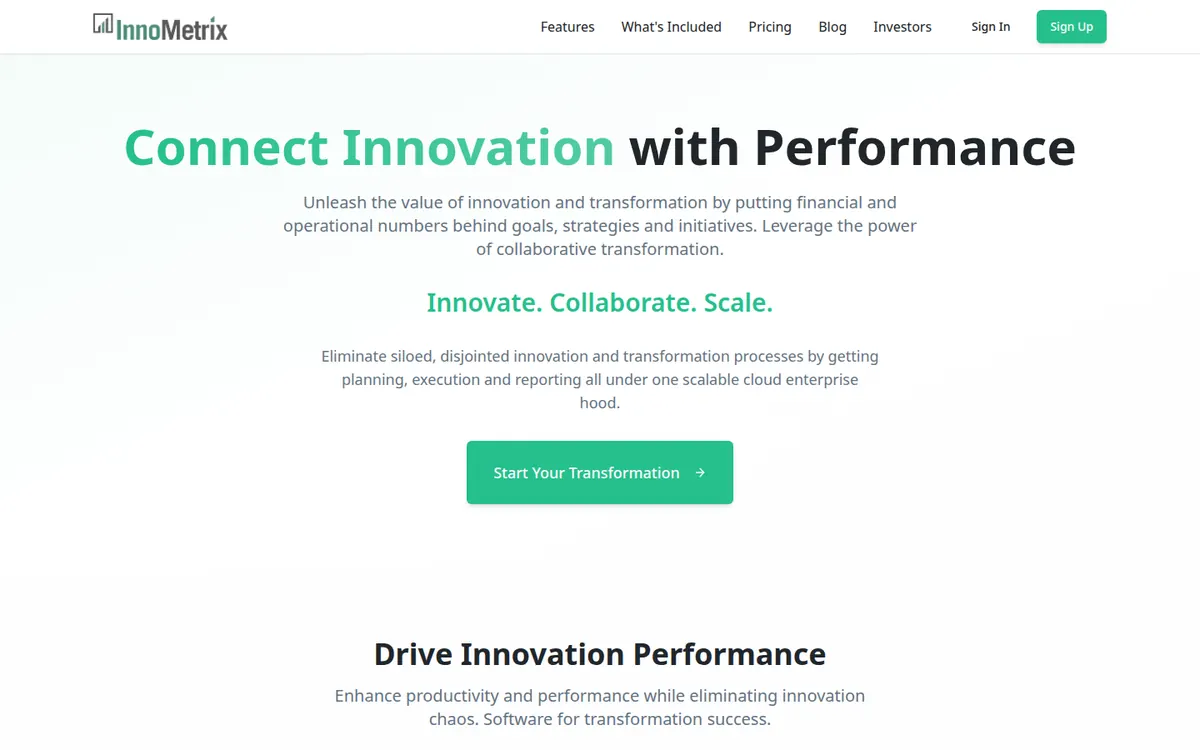
InnoMetrix is an innovation performance management platform for enterprise transformation teams. It puts financial and operational numbers behind goals, strategies and initiatives: organizations plan and align initiatives through a stage-gate approval process, track IRR, payback, NPV and KPIs of their choosing, and analyze portfolio performance in dashboards and reports, with planning, execution and reporting in one cloud product.
The engagement was the consulting portal behind that product and the AWS platform under it - the place where a consulting team works with its client organizations: clients, teams, documents, settings, notifications, and periodic snapshots of how each portfolio is performing.
The backend is a serverless TypeScript monorepo: one Lambda per controller folder behind an API Gateway REST API, written on an in-house framework the studio carries between projects. That framework is decorator-driven - @Controller on the class, @Get, @Post, @Put and @Patch on the methods, @MongodbService for data access, a LambdaApplication that wires it together - so a controller reads like a small service rather than like a pile of handler files, and the split into functions is a directory convention instead of a deployment decision taken by hand.
Data lives in Amazon DocumentDB reached through the MongoDB driver, with the host and password pulled from SSM Parameter Store and Secrets Manager rather than from configuration, and the functions themselves running inside private VPC subnets. Schema changes go through migrate-mongo - around twenty migrations in the repository - and node_modules ship as a Lambda Layer so the deployment package stays small. Background work runs as its own functions: an events handler and a snapshots handler, both on EventBridge schedules.
Identity is Amazon Cognito, but authorization is the platform's own: a custom Lambda authorizer validates the JWT, then a policies, roles, groups and users model in the framework's access-manager package decides what the caller may touch. An export API is mounted deliberately outside the authorizer, so integrations can pull data without a portal session.
The portal itself is a React single-page app - React 17 on Create React App, routed with React Router and lazy-loaded pages behind a ProtectedRoute, styled with MUI and Emotion over a large SCSS layer. The working surfaces are the ones a consulting engagement actually needs: DevExtreme data grids for portfolio tables, Formik and Yup forms for the stage-gate steps, ApexCharts, Chart.js, gauges and sparklines for KPI dashboards, rich-text editing, drag-and-drop reordering, a calendar and maps. Axios interceptors attach the bearer token and log the user out on a 401, so an expired session ends cleanly instead of failing page by page. The build ships as static files to S3 behind CloudFront.
The public marketing site is a separate project and not part of that work: it ran on a HubSpot theme in 2024-2025 and on a Lovable and Supabase build from 2026.
What was built
- A serverless TypeScript backend on AWS Lambda behind an API Gateway REST API, with one function per controller directory.
- Twelve domain controllers covering documents, clients, teams, notifications, settings and portfolio snapshots.
- An in-house decorator framework shared across the studio's projects: controller and route decorators, a MongoDB service decorator and an application class that assembles them, alongside config, errors, notifications and utility packages in a yarn-workspaces monorepo.
- Authorization as its own subsystem: Cognito for identity, a custom Lambda authorizer for the JWT, and a policies, roles, groups and users model deciding access.
- A public export API mounted outside the authorizer for integrations that have no portal session.
- Amazon DocumentDB access through the MongoDB driver, with credentials from SSM and Secrets Manager and functions running in private VPC subnets.
- Around twenty migrate-mongo migrations carrying the schema forward.
- Background jobs on EventBridge schedules: an events handler and a snapshots handler that record how portfolios are performing over time.
- AWS CDK infrastructure in TypeScript, with node_modules shipped as a Lambda Layer.
- A local development setup on the Serverless Framework with serverless-offline, its configuration generated in TypeScript rather than maintained by hand.
- A React single-page portal: lazy-loaded routes behind a ProtectedRoute, MUI and Emotion over an SCSS layer, DevExtreme data grids, Formik and Yup forms, and dashboards on ApexCharts, Chart.js, gauges and sparklines.
- Session handling in one place: axios interceptors attach the bearer token and log the user out on a 401.
- Editing and planning surfaces the portal needs: rich-text editors, drag-and-drop reordering, a calendar and Leaflet maps.
- A static build deployed to S3 and served through CloudFront, with an Apache fallback config for single-page routing.
- Tests on Jest with an in-memory MongoDB, and ESLint with TypeScript rules and conventional commits across the monorepo.
Stack
Backend
- TypeScript on AWS Lambda
- Serverless monorepo, one function per controller directory
- API Gateway (REST)
- The portal's HTTP surface in front of the functions
- In-house @datasub framework
- Decorators for controllers, routes and MongoDB services, with an application class assembling the Lambda
- Node.js
- Lambda runtime, with a matching runtime for local offline runs
Data
- Amazon DocumentDB
- Primary store, reached through the MongoDB driver
- migrate-mongo
- About twenty migrations carrying the schema forward
Security & Access
- Amazon Cognito
- User pool for identity
- Custom Lambda authorizer
- JWT validation in front of the API
- Policies, roles, groups and users
- The platform's own authorization model in the framework's access-manager package
- SSM Parameter Store + Secrets Manager
- Database host and credentials, kept out of configuration files
Frontend
- React 17 (Create React App)
- Single-page portal, routed with React Router and lazy-loaded pages behind a ProtectedRoute
- MUI + Emotion
- Component library and styling over a large SCSS layer
- DevExtreme
- The portal's main data grid for portfolio tables
- Formik + Yup
- Forms and validation for stage-gate and settings screens
- axios with interceptors
- Bearer token on every request and automatic logout on a 401
- ApexCharts, Chart.js, gauges, sparklines
- KPI and portfolio dashboards
- Rich text, drag-and-drop, calendar, Leaflet
- Editing, reordering, scheduling and mapping surfaces
Infrastructure & DevOps
- AWS CDK (TypeScript)
- Infrastructure as code, functions in private VPC subnets, node_modules as a Lambda Layer
- EventBridge
- Schedules for the events and snapshots background jobs
- SES, SQS, CloudFront
- Mail, queues and content delivery around the platform
- S3 + CloudFront
- Static hosting for the portal build
- Serverless Framework + serverless-offline
- Local runs of the same functions, configured from TypeScript
Tooling & QA
- Jest + ts-jest
- Backend tests against an in-memory MongoDB
- ESLint + typescript-eslint, Prettier
- Linting across the backend monorepo and the portal
- yarn workspaces, conventional commits
- Monorepo package management with a commit convention enforced by tooling
Engineering highlights
The studio brought its own framework rather than the client's: decorators for controllers, routes and data access mean a new domain is a directory and a class, and the mapping from code to deployed Lambdas is a convention rather than a hand-maintained list.
Identity and authorization are deliberately separate - Cognito says who you are, the platform's own policies, roles and groups model says what you may touch - which is what a portal serving several client organizations needs.
The snapshots job is the product's memory: portfolio performance is recorded on a schedule, so the dashboards can show how initiatives moved rather than only where they stand today.
One export API sits outside the authorizer on purpose, so integrations pull data without pretending to be a logged-in user.