Guardian Shield Systems
Software around a 36-axis hot-wire line that cuts foam billets into building panels, delivered ahead of its commissioning: an independent audit of the PLC project, a machine console on the Bosch Rexroth ctrlX CORE controller, and an AI support assistant grounded in the machine's own drawings and drive manuals.
Overview
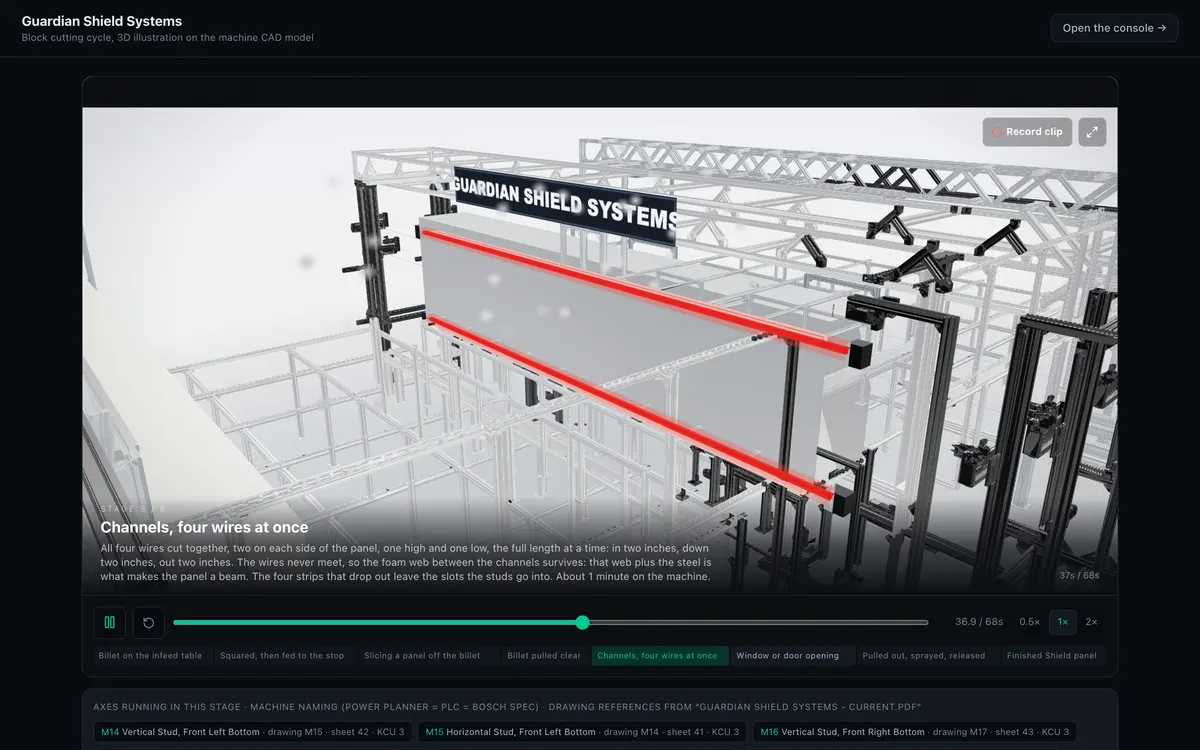
Guardian Structural Technologies makes Guardian Shield panels, an engineered thermal envelope panel system for residential and commercial buildings. The panels are cut out of foam billets, and the company is building an automated line to do it: an infeed table, a cutting section and an outfeed table in a row, 36 servo axes and six hot wires. A raw billet 18 feet long is squared against a fence and pushed to a stop, a vertical wire slices a panel off its face, four wires cut the channels for the structural steel in one pass, and an overhead wire traces the window and door openings. Motion runs on a Bosch Rexroth ctrlX CORE with IndraDrive Mi drives, and the cutting paths arrive as G-code, one program per wire.
The engagement began in May 2026 and runs on two tracks, both ahead of commissioning. The first is the control software. The PLC project - IEC 61131-3 Structured Text written by the client's controls developer - came in for an independent review before the machine is powered up. The review had to be static: the ctrlX PLC Engineering project is a single encrypted binary that opens only in the vendor's Windows IDE, so it worked from a text export of all 46 program blocks, read line by line and cross-checked against the supplied documentation and the motion library calls. The report ranks findings by consequence, separates what is a fix from what is a question of design intent, says plainly what could not be checked without the device configuration, and ends with 15 questions for the developer rather than verdicts. A companion analysis covered how the hot-wire power controllers should reach the PLC, fieldbus module or analog I/O, a decision that had to land while the panel was still being built.
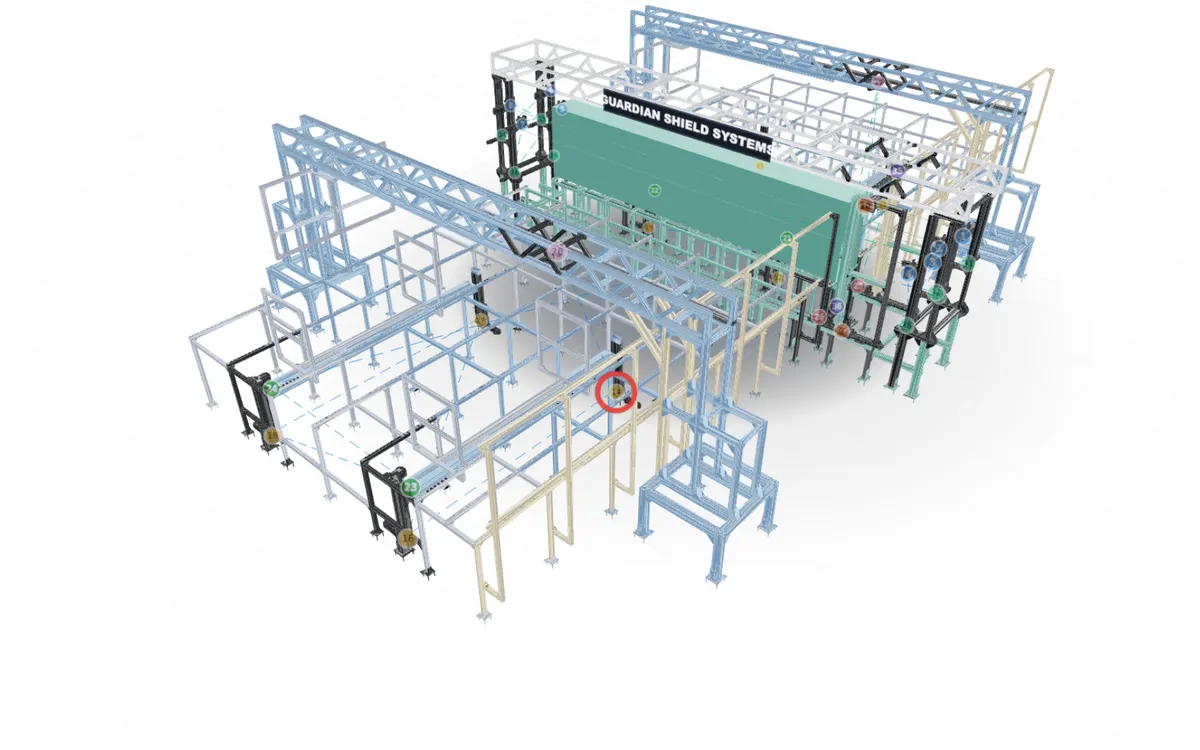
The second track is everything an operator and a maintenance technician need around the controller, built as one web console. It talks to the ctrlX CORE through the Data Layer: REST for browsing, reads and typed writes, server-sent events for live values. Its home screen is a machine map. All 36 axes are located on the real geometry, converted from the client's STEP assembly into a web 3D model, and each one is tied to its name in the PLC and the process specification, its sheet in the electrical drawings and its drive chain. A new alarm flies the camera to the faulted component. Around the map sit a fault logbook, cases that open themselves from alarms, maintenance with a per-shift pre-start checklist, escalation by email and SMS, security and network views, backups, and an admin side with usage and cost metering.
The assistant inside the console answers in English and Spanish from the machine's own paper: nine source PDFs, 2,531 pages in all - the 62-sheet electrical drawing set and the drive manuals, the largest of them 1,442 pages - plus the bill of materials, the process specification and assembly facts read out of the CAD file. Answers cite the document and the page, and the citation opens the PDF at that page. It can read the controller through tools, and it can propose a write, but only a person confirming in the interface executes one.
The status is stated as it is. The machine is not commissioned yet, and today the console is bound to a ctrlX CORE on a test bench that exposes a single axis. The 36 axes on the map come from the CAD model, the drawings and the bill of materials, an axis that is not bound to the controller never shows an invented live state, and binding the full machine is a written procedure waiting for the day it comes online.
What was built
- An independent pre-commissioning audit of the PLC software: all 46 program blocks of the Structured Text project read line by line, findings ranked by consequence, and 15 questions for the controls developer.
- A machine map as the console's home screen: 36 servo axes on the real machine geometry in 3D and in plan and elevation views, each with its PLC name, drawing sheet, drive chain, live status, fault history and bound maintenance.
- A CAD-to-web pipeline: the STEP assembly (113 products, 10,556 placed part instances) converted to GLB, CAD colours baked in, small parts stripped, meshes bucketed per axis and per zone, then compressed into a high-quality and a lite model.
- A ctrlX CORE integration over the Data Layer REST API: token auth, node browse, read and metadata, live values over server-sent events, a per-minute sampler and a scan that opens cases from real diagnoses.
- Guarded device writes: the assistant can only propose one, a person confirms it in the interface, and execution passes a kill switch, a role or plant-network allowlist, a rate limit and an audit log.
- A support assistant in English and Spanish over 2,531 pages of drawings and drive manuals, the bill of materials, the process specification and CAD assembly facts, with citations that open the source PDF at the cited page.
- A fault knowledge base: a catalogue of 290 drive and controller fault codes, a 309-entry troubleshooting glossary, and a Fault Lab that generates an answer per fault, scores its grounding, has a second model judge it and serves only what passes.
- Cases, maintenance and escalation: cases opened from alarms or by hand with their own chat, next action, owner and parts; recorded fixes fed back into the assistant's context; a per-shift pre-start checklist; email and SMS alerts by severity.
- A 3D film of the block-cutting cycle on the machine's CAD model: eight stages, each captioned with the axes running and their drawing references, rebuilt through four review rounds with the machine's architect and published on a login-free link.
- A program mode that reads the machine's own wire programs: a parser for ctrlX NPG G-code and the older FANUC-style dialect, each wire drawn in the plane it is steered in, with a scrubber over the whole job. Parsed in the browser, nothing goes near the controller.
- Role-based access: a kiosk sign-in for operators, accounts for technicians, managers and engineers, and raw fault codes shown only to the roles that can act on them.
- A read-only MCP server exposing the same controller tools the built-in chat uses, plus a standalone toolkit: a Python client and CLI for the Data Layer and a Telegraf, InfluxDB and Grafana stack for long-term metrics.
- A provenance record for the machine's data: every file, email and call logged the day it arrives, and a crosswalk that settled the axis numbering between the drawings, the PLC and the process specification.
Stack
Controls & machine
- Bosch Rexroth ctrlX CORE
- Motion controller of the line on ctrlX OS: 36 coordinated servo axes with IndraDrive Mi near-motor drives.
- IEC 61131-3 Structured Text
- The PLC project under audit: programs, function blocks, global variable lists and data types, reviewed from a text export of the ctrlX PLC Engineering project.
- PLCopen motion blocks
- Axis power, reset, homing and absolute moves, with electronic gearing between master and slave axes; the audit checked the code against the ctrlX motion library it calls.
- ctrlX Data Layer REST API
- Token auth, node browse, read, metadata and typed writes, with server-sent events for live values.
- G-code (ctrlX NPG)
- One cutting program per hot wire, parsed in the console for preview, including the older FANUC-style dialect.
Frontend
- Next.js 16 + React 19
- The console: machine map, assistant, faults, cases, maintenance, security, network and admin, in TypeScript with Tailwind 4, English and Spanish.
- three.js
- The 3D machine map with orbit, markers, fly-to on a fault and drive-chain lines, and the cutting cycle film.
- Recharts
- Fault frequency, faults by operator and shift, a 48-hour fault timeline and escalation response.
Backend
- Next.js API routes
- Assistant chat over SSE, controller reads and confirmed writes, cases, maintenance, alerts, backups and admin reports.
- MCP server
- Stateless Streamable HTTP endpoint with read-only controller tools, the same toolbox the built-in chat uses.
- Python
- Data Layer client and CLI for the controller, and the script that converts the CAD assembly into the web model.
Data
- Supabase / Postgres
- A dedicated schema for this client on a shared instance, row-level security, private storage buckets for backups and knowledge-base uploads.
- Turbopuffer
- Vector namespace for the machine's corpus; every chunk carries source file, page, section and part numbers so an answer can cite it.
- Upstash Redis
- Rate limiting, including the ten-per-minute limit on controller writes.
AI
- Claude
- Sonnet for answers and controller tool use, Haiku as the judge in the Fault Lab.
- Voyage AI
- voyage-4-large embeddings at 2,048 dimensions and reranking of retrieved chunks.
- pdf.js + Tesseract.js
- In-app knowledge-base ingestion on serverless: PDF text extraction with an OCR fallback for scanned documents.
3D & CAD
- STEP AP214 to GLB
- cascadio conversion of the SolidWorks assembly, CAD colours baked into vertex colours, parts bucketed into one mesh per axis and per zone.
- gltfpack
- Mesh simplification and compression into a high-quality model of about 14 MB and a lite one of about 5 MB for weak GPUs.
Infrastructure & DevOps
- Vercel
- Hosting and four cron jobs: controller sampling every minute, the case scan every five, a nightly backup and a weekly report.
- Telegraf + InfluxDB + Grafana
- Docker Compose stack for long-term controller metrics, fed by Telegraf's native ctrlX Data Layer input.
Integrations
- Twilio SMS
- Alert delivery to escalation contacts by severity, next to email.
- Nodemailer
- Email for fault alerts and the scheduled weekly report.
Tooling & QA
- Vitest
- 94 test files, among them the safety gate, the G-code parser, the cycle kinematics and the integrity of the 3D model assets.
- Playwright
- End-to-end specs plus headless smoke scripts for the 3D map, the live binding, the mobile console and the guided demo.
Engineering highlights
Safety is code, not tone. A prompt contract rules out live-voltage procedures and makes a safety section mandatory, and behind it a deterministic gate scans every generated answer, in English and Spanish, for anything that reads like bypassing an interlock, a guard, STO or an E-stop, and replaces it with a stop-and-escalate message. The gate understands negation, so the required warning 'never bypass the interlocks' passes while the instruction fails closed.
A second deterministic gate handles fabrication. Every drive parameter or command id an answer cites has to exist somewhere in the manual corpus, otherwise the answer is blocked and never served. Together with cross-page chunk overlap and an abstention rule it took hallucinated fault answers in the Fault Lab from 60 to 36, none of them served.
The 36 axes were identified from three sources that had to agree: the CAD assembly for positions, the bill of materials for the count - exactly 36 servo motors against 36 drives - and the electrical drawings for identity, where sheets 35 to 52 are the 36 motor nodes. Where a mapping is inference rather than something the drawings state, the interface marks it as tentative.
The cutting film is a reviewed specification as much as a picture. The cycle was written out in plain words, corrected by the machine's architect line by line, and the film is checked against that text. The code keeps what is sourced apart from what is assumed, the step durations are labelled as estimates, and the page says it is time compressed.
An audit without a compiler. With the PLC project locked inside an encrypted binary, the review ran on a text export kept in git as a diffable mirror of the real project, and the report is explicit about its limits: nothing was compiled or run, and the device configuration was out of scope.