HighRiskGateway
Independent guide to merchant accounts and gateways for the businesses mainstream processors decline: what the high-risk label actually prices in, the four ways a company earns it, the verticals acquirers flag, and how the terms differ - 3.5 to 6 percent against 2.5 to 3, rolling reserves held 90 to 180 days, delayed settlement, manual underwriting.
Overview
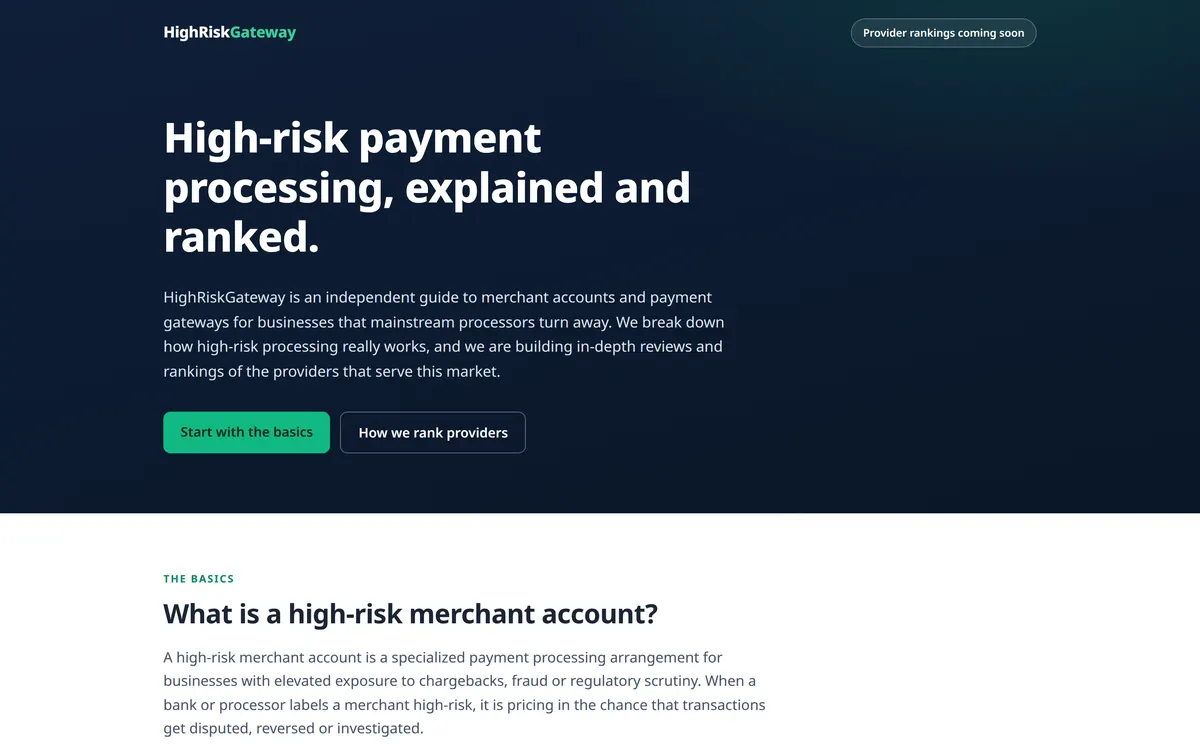
HighRiskGateway is an editorial guide to merchant accounts and payment gateways for the businesses mainstream processors decline: CBD and cannabis, supplements, travel, gambling, adult, tobacco and vaping, crypto, firearms, subscriptions, high-ticket dropshipping. The premise is that the high-risk label is priced risk rather than a verdict - plenty of legitimate companies live there, and picking the processor is one of the most consequential decisions they make.
The first published page is the explainer the market is missing: what a high-risk merchant account actually is, the four ways a business ends up labelled one - chargeback exposure, regulatory scrutiny, thin or damaged financial history, and transaction patterns such as high tickets, card-not-present and cross-border volume - and a side-by-side of how the terms differ from a standard account, from 3.5 to 6 percent processing against 2.5 to 3, to rolling reserves of 5 to 10 percent held for 90 to 180 days, delayed settlement, manual underwriting and stiffer contracts. Ranges are published as typical market ranges, not as quotes.
Provider reviews and rankings are declared before they exist, with the six criteria they will be judged on - industry specialization, fee transparency, contract flexibility, fraud and chargeback tooling, payout reliability and support quality - stated up front rather than reverse-engineered once the first affiliate deal arrives. The site states plainly what it is not: not a payment processor, and not a source of financial, legal or compliance advice.
Technically it is deliberately small: a static Astro 7 build on Cloudflare with one CSS bundle, no client-side framework, no tracking beyond what the host provides, and robots and a sitemap index in place from day one so the pages are indexable as they land.
What was built
- A static Astro 7 site on Cloudflare: a single long-form page today, structured so provider reviews and rankings drop in as their own routes.
- The explainer itself: definition, a four-part classification of why businesses get labelled high-risk, twelve verticals acquirers flag almost everywhere, and a standard-versus-high-risk comparison table covering fees, reserves, settlement, underwriting and contract terms.
- A published ranking methodology - six criteria, stated before the first review - so the rankings can be held to it.
- An FAQ section answering the questions merchants arrive with, and an explicit disclaimer that the site is not a processor and gives no financial, legal or compliance advice.
- Indexing plumbing from launch: robots.txt allowing everything and a sitemap index, so new review pages are picked up as they publish.
Stack
Frontend
- Astro 7
- Static build; the page ships as HTML with one CSS bundle and no client-side framework
Infrastructure & DevOps
- Cloudflare Pages
- Hosting and deploys for highriskgateway.com and www
Content & SEO
- robots.txt and sitemap index
- Open to all crawlers from launch, with a sitemap index ready for review pages
Engineering highlights
The ranking criteria are published before the rankings, which is the opposite of how most affiliate-funded comparison sites in this niche are built.
Numbers are framed as typical market ranges rather than quotes, and the page says so - the honest version of a table that competitors publish as if it were a price list.
The disclaimer is load-bearing, not decorative: an independent guide that is not a processor and gives no compliance advice can write about MATCH listings and terminated accounts without a conflict.
A one-page site that is already structured as a section: methodology, verticals and comparison tables are the scaffolding the provider reviews will hang from.