Astaria
NFT-collateralized lending protocol: borrow ETH against NFTs instantly, lend into vaults, buy discounted NFTs from liquidated loans.
Overview
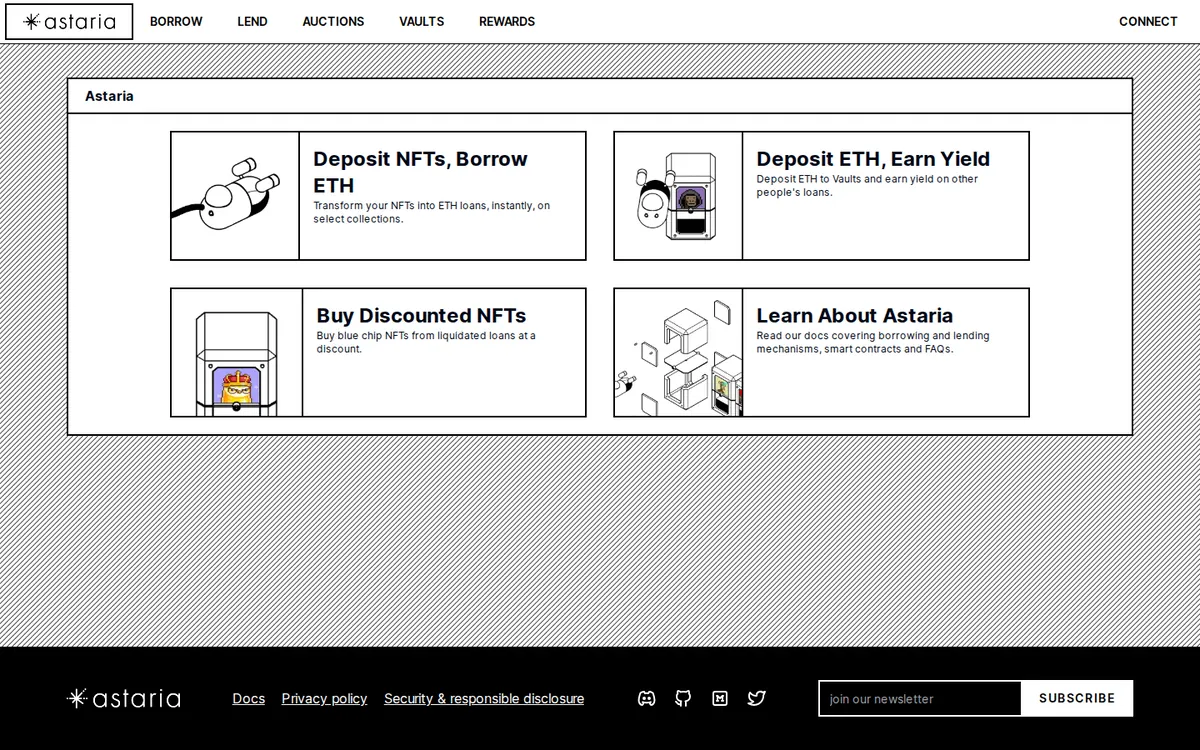
Astaria was an NFT-collateralized lending protocol on Ethereum, pitched on its site as instant liquidity for NFTs. Holders of NFTs from select collections could borrow ETH against them, lenders deposited ETH into vaults to earn yield on other people's loans, and NFTs from liquidated loans went to auction, where buyers could pick up blue chip pieces at a discount.
Data Subsystems worked on both sides of the platform, alongside Astaria's in-house engineers. The infrastructure was built on AWS: a load balancer, ECS, EC2, SQS, S3, Lambda, Database Migration Service, API Gateway and Amazon MSK, with on-chain data indexed through a Subgraph and StreamingFast Substreams and some tasks built on NestJS REST and GraphQL APIs. On the frontend, the team contributed to the Next.js 13 lending app.
By April 2023 the app covered borrowing, lending vaults, vault creation for strategists, auctions and liquidations, strategist profiles and a dashboard, running on Ethereum mainnet in production and the Goerli testnet in staging. Astaria has since wound down and its site is offline, so the screenshot comes from the Wayback Machine, January 2024.
What was built
- Borrow flow: choose NFTs as collateral, get loan offers through the Astaria SDK's offer router, check out the loan and follow open positions under Your Loans.
- Lending screens to browse all vaults and loans, deposit ETH into a vault and track deposits and withdrawals through each vault's withdraw proxies.
- Vault creation for strategists: name, short description and long thesis, profile image, public or private access and accepted collateral, then deployment through the Astaria router contract.
- Auctions and liquidations: live auctions for expired loans, a bids view, claiming the asset as liquidator, and a self-liquidation option for borrowers.
- Dashboard with borrow, lend and auction summary charts, strategist profile pages and a shared transaction modal for on-chain actions.
- Terms acceptance, privacy pages including a California notice, and a restricted-wallet notice for addresses on OFAC's SDN list.
- Backend infrastructure on AWS with Subgraph and StreamingFast Substreams indexing and NestJS REST and GraphQL APIs.
- Delivery pipeline: GitHub Actions running lint, a production build and Jest tests for the staging and master branches, with Storybook for component work and Sentry for error tracking.
Stack
Frontend
- Next.js 13
- Framework for the lending app: borrow, lend, auction and strategist pages plus a few API routes
- Mantine 5
- Component library and theming, including the collateral, transaction and terms modals
- React Query
- Fetching and caching loan data on the borrow screens, with a persisted query cache
- Zustand
- Cart-style stores for the NFTs picked as collateral and the transactions queued in the borrow flow
- Recharts
- Line charts in the borrow, lend and auction summaries on the dashboard
Backend
- NestJS REST / GraphQL
- REST and GraphQL APIs used for part of the backend work
Data
- Subgraph
- Indexing on-chain protocol data so the platform could query it
- StreamingFast Substreams
- Blockchain data streaming and indexing, used alongside the Subgraph
Infrastructure & DevOps
- AWS ECS, EC2, ALB
- Container services and instances behind an application load balancer
- AWS Lambda, API Gateway
- Serverless functions and API endpoints within the platform's AWS infrastructure
- AWS SQS, MSK
- Message queues and managed Kafka for moving data through the backend
- AWS S3, DMS
- Object storage and the Database Migration Service in the same AWS setup
- Vercel
- Frontend hosting, configured with HSTS and other security response headers
- GitHub Actions
- Lint, production build and Jest tests on pushes and pull requests to staging and master
- Sentry
- Error monitoring on client and server, with breadcrumbs recording each transaction's creation, success or failure
Integrations & Payments
- Center API
- Looking up the NFTs a wallet owns and their token metadata for the borrow screens
- Etherscan API
- Block explorer data requested through a server-side Next.js API route
Web3
- wagmi
- React hooks for wallet accounts and contract writes, including vault deployment
- ethers v5
- Providers, BigNumber math and raw contract calls throughout the app
- ConnectKit
- Themed wallet connection modal wrapped around the wagmi client
- Astaria SDK
- The protocol's TypeScript SDK: router and vault contract factories and collateral id generation
- TypeChain
- Typed bindings for the vault and withdraw-proxy display-data helper contracts
- Mainnet, Goerli, Hardhat
- Ethereum mainnet in production, Goerli for staging and a local Hardhat chain for development
Tooling & QA
- TypeScript
- Typed codebase across pages, hooks and contract bindings, with a separate typecheck script
- Jest + Testing Library
- Component and snapshot tests, run before commits and in CI
- Storybook
- Isolated development of components such as the charts, with a dark-mode addon
- Husky + commitlint
- Git hooks running tests and lint-staged, and enforcing Conventional Commit messages
Engineering highlights
Vault listings merge an off-chain vaults API with on-chain figures read in a single eth_call: a display-data helper contract is executed from its constructor without ever being deployed, returning data for many vaults at once.
Contract access leans on Astaria's own TypeScript SDK (router and vault contract factories, the offer router) plus TypeChain bindings for the display-data helper contracts.
Quality gates on commit and in CI: tests and lint-staged before each commit, Conventional Commit checks on every message, and lint, build and tests in GitHub Actions for staging and master.
The backend combined on-chain indexing (Subgraph, StreamingFast Substreams) with AWS queueing and streaming through SQS and Amazon MSK.