Hidden Hand
Marketplace where protocols incentivize vote-escrow token holders, and the dApp around BTRFLY staking and governance.
Overview
Hidden Hand is a marketplace for governance incentives, commonly called bribes. Protocols with vote-escrow tokens use it to let others reward their token holders for gauge votes, and holders earn extra yield on their governance tokens. In 2023 it was a Redacted platform: marketplace revenue was shared with rlBTRFLY holders, and Hidden Hand was also the dApp around BTRFLY, where users staked tokens, earned incentives and took part in governance proposals.
Data Subsystems handled frontend development. The app was built on Next.js with Mantine, and the Web3 layer is where the work sat: wallet connection through RainbowKit over wagmi, transaction flows and contract calls through ethers.js and web3.js, and a data layer that reads the protocol's subgraph over GraphQL with graphql-request, cached and kept in sync by TanStack Query so a page full of market numbers does not re-query the chain on every render. The March 2023 version opened on a short explainer and a protocol picker, gave each partner protocol its own market page (Aura, Balancer, Bunni, FloorDAO, Frax, Idle Finance, Ribbon, Saddle and Tokemak at the time), and added a Claim page and wallet connection.
Seen from a participant's side, the app is one loop: connect a wallet, hold the protocol's token and with it the right to vote on where emissions go, watch what that vote is worth on the market, claim it - and, on the market side, let what has been accumulated change hands between participants rather than sit idle.
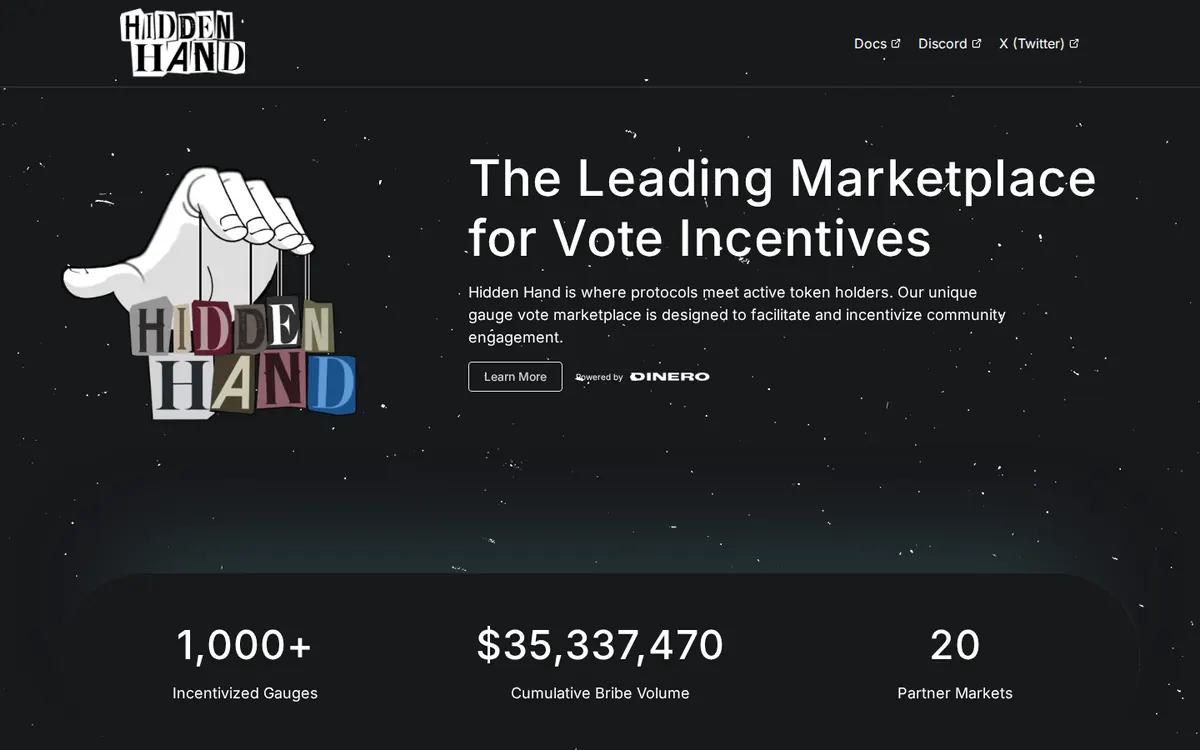
The site is still up, now powered by Dinero, listing 20 partner markets and a calendar of voting rounds. It also carries a wind-down notice: new markets were offered until 31 December 2025, a claims-only period ran from 1 January to 30 June 2026, and rewards left unclaimed after that deadline expire.
What was built
- Landing view explaining the marketplace and the rlBTRFLY revenue share, with links to protocol statistics and documentation and a prompt to select a protocol.
- A market page per partner protocol, each on its own route such as /balancer, /aura or /frax.
- Claim page where users collect the incentives they have earned.
- Wallet authentication through RainbowKit over wagmi, so a visitor becomes a participant in one connect rather than a chain of prompts.
- Transaction flows and contract interaction through ethers.js and web3.js: voting, claiming and the market actions behind them.
- A GraphQL data layer with graphql-request, wrapped in TanStack Query for caching, refetching and request de-duplication across the market pages.
- Staking, incentive and governance-proposal flows for BTRFLY, the token the dApp was built around.
- Unit tests over the contract-interaction and data code.
Stack
Frontend
- Next.js
- Application framework, with one route per partner protocol market and a separate claim page
- Mantine
- Component library behind the UI, visible throughout the archived March 2023 markup
- @tanstack/react-query
- Caching, refetching and de-duplication for market and position data
Web3
- wagmi
- React hooks over the chain: accounts, connectors, reads and writes
- @rainbow-me/rainbowkit
- Wallet connection and the account UI on top of wagmi
- ethers.js
- Ethereum contract interaction behind the markets, claims and staking
- web3.js
- Wallet and chain access in the dApp, alongside ethers.js
Data
- GraphQL + graphql-request
- Queries for market, round and position data that the chain itself cannot serve in that shape
Engineering highlights
Each protocol market lives on its own URL (/balancer, /aura, /frax and so on), so markets can be linked directly; the live site still uses the same route pattern.
Two read paths, on purpose: GraphQL for what a market page shows - rounds, offers, historical numbers - and direct contract calls for what has to be true at the moment of a transaction.
Wallet connection is the sign-up: there is no account to create, so the whole funnel from visitor to voter is one connect and one transaction.