SeamlessPay
Payment optimization platform: intelligent routing, approval rates, chargeback reduction.
Overview
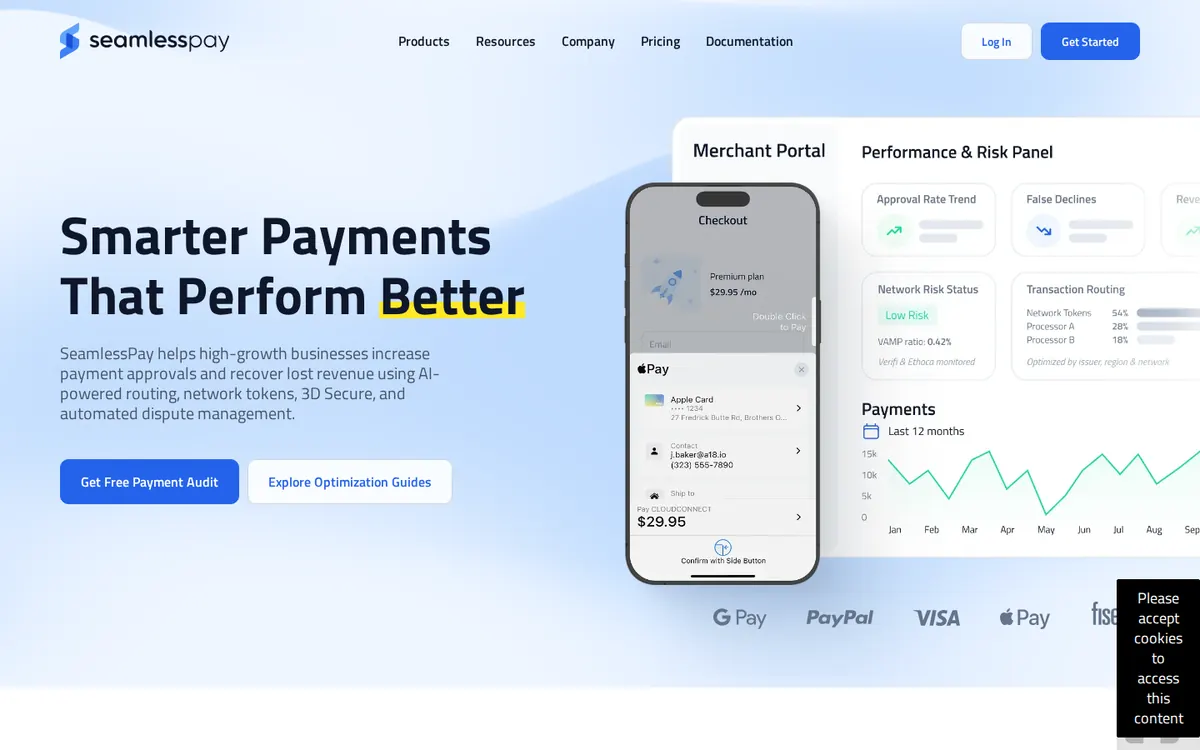
SeamlessPay is a payment optimization platform for high-growth businesses. It sits above payment processors to raise approval rates and reduce losses from false declines, fraud and chargebacks, combining smart routing, network tokens, account updater and intelligent retries with adaptive 3D Secure, real-time fraud scoring, Verifi and Ethoca alerts and AI-assisted dispute handling, through one integration and without locking a merchant into a single processor.
Behind that product sits the platform itself. The payment core is a set of microservices on AWS Lambda behind API Gateway, with the heavier and longer-running services in ECS Fargate containers behind a load balancer, scaling task count up and down with load. Card transactions run through a First Data integration, ACH through integrations with several different processors, and PayPal alongside them. The API is not an internal detail: physical payment terminals transact through it, so it is a public contract with hardware in the field on the other end.
On the client side there is a payment web SDK built the way Braintree builds one - card fields in an iframe, cross-frame messaging over framebus, promise wrapping - with card validation and card-type detection, and a separate package that masks and restricts what can be typed into a card field. Both are released by semantic-release, and the input package is tested in real browsers through WebdriverIO on BrowserStack rather than in a headless approximation of them.
The backend packages run on Feathers.js with socket.io and JWT authentication over MongoDB, deployed through the Serverless framework with Step Functions, run locally against localstack and fed credentials from encrypted credential storage. Infrastructure is AWS CDK v2 in TypeScript with Sentry wired in, and the whole thing is delivered by GitHub Actions: infrastructure deploys automatically, but only after the unit tests pass - a red test suite means no deploy. Exceptions and system events land in Slack channels rather than in a log nobody reads, and merchant portals are built in React and Mantine with Next.js and NestJS.
Because card data is held rather than passed through, the platform lives under audit. Card numbers are stored only encrypted; the database has no route in from the internet; CloudWatch logs are checked to make sure no card numbers and no personal data end up in them, with logging hygiene treated as its own requirement; and the cardholder data environment is a separate infrastructure stack of its own rather than a wing of the main one.
Its public site, seamlesspay.com, runs on WordPress with a site-specific theme and Genesis Blocks, hosted on WP Engine behind Cloudflare. It presents the product suite, use cases, practical guides and interactive tools such as a VAMP calculator and a chargeback cost calculator, captures audit requests through HubSpot forms, and links out to developer documentation, the merchant portal and a public status page.
What was built
- A microservice payment core on AWS Lambda behind API Gateway, with heavier services in ECS Fargate behind a load balancer and task counts that follow load.
- Processor integrations: First Data for credit card transactions, several different ACH processors, and PayPal.
- A terminal-facing API treated as a public contract, since physical payment terminals transact through it.
- A payment web SDK on the Braintree architecture - iframed card fields, framebus messaging, wrapped promises - with card validation and card-type detection.
- A restricted-input package in TypeScript that masks and constrains card entry, tested across real browsers with WebdriverIO on BrowserStack.
- Backend services and packages on Feathers.js with socket.io and JWT auth over MongoDB, deployed with the Serverless framework and Step Functions, runnable locally against localstack.
- Infrastructure as code in AWS CDK v2 and TypeScript, with Sentry for error tracking and SES identity setup handled in the stack.
- GitHub Actions pipelines that deploy infrastructure automatically and only after unit tests pass.
- Merchant portals in React and Mantine on Next.js and NestJS.
- Slack alerting on exceptions and system events, so failures surface where the team already is.
- A separate cardholder data environment as its own AWS CDK stack, isolating the PCI scope from the rest of the platform.
- The controls audits ask for: card data encrypted at rest, a database with no internet-facing route, and CloudWatch logs verified to hold no card numbers or personal data.
- Product pages for payments, invoicing, subscriptions, in-person terminal, payment facilitation, Sonar fraud detection, business capital and 3D Secure on the marketing site.
- Guides on chargeback prevention, payment orchestration, high-risk payments, 3D Secure and tokenization, plus interactive VAMP and chargeback cost calculators and a HubSpot audit-request form.
Stack
Backend
- AWS Lambda + API Gateway
- The payment core as microservices behind one API surface
- ECS Fargate
- Containerised services behind a load balancer, autoscaling on load
- Feathers.js
- Backend services with socket.io and JWT authentication
- NestJS
- Backend behind the merchant portals
- Serverless framework
- Deployment of the functions, with Step Functions for multi-step flows
Frontend
- React + Mantine
- Merchant portal interfaces
- Next.js
- Portal application framework
- Payment web SDK
- Braintree-style architecture: iframed card fields, framebus messaging, promise wrapping, card validation and card-type detection
- restricted-input
- TypeScript package masking and constraining card entry
Data
- MongoDB
- Store behind the backend services
- Encrypted card storage
- Card numbers held only in encrypted form, in a database with no route in from the internet
Infrastructure & DevOps
- AWS CDK v2 (TypeScript)
- Infrastructure as code for the platform and, separately, for the cardholder data environment
- GitHub Actions
- Automatic deploys gated on a passing unit-test run
- Sentry
- Error tracking wired into the service wrapper
- Slack alerting
- Exceptions and system events routed to channels the team watches
- localstack
- Local AWS for running the serverless services without a cloud account
Integrations & Payments
- First Data
- Credit card transaction processing
- ACH processors
- Integrations with several different ACH processors
- PayPal
- Alternative payment method alongside cards and ACH
- Payment terminals
- Physical terminals transacting through the platform API
Security & Compliance
- PCI cardholder data environment
- Its own infrastructure stack, separate from the main platform
- Log hygiene
- CloudWatch logs checked for card numbers and personal data as a standing requirement
- Encrypted credential storage
- Service credentials pulled from an encrypted store rather than from configuration
Tooling & QA
- Jest
- Unit and integration tests across the backend packages and infrastructure code, with coverage reporting
- WebdriverIO + BrowserStack
- Real-browser tests for the card input package
- semantic-release
- Versioning and publishing of the SDK packages
- Lerna monorepo
- Package management across the platform's JavaScript packages
CMS & Commerce
- WordPress on WP Engine
- The marketing site, with a site-specific theme, Genesis Blocks and HubSpot forms, behind Cloudflare
Engineering highlights
The API had hardware on the other end: physical terminals in the field transacted through it, which turns every breaking change into a field problem rather than a deploy note.
Deploys are gated on tests by construction - GitHub Actions rolls out infrastructure only after the unit suite passes, so a red suite is not a judgement call.
The card SDK borrows an architecture that has already survived PCI scrutiny - Braintree's iframed fields and cross-frame messaging - instead of inventing one, and the input-masking package is tested on real browsers because card fields break in browsers, not in jsdom.
The cardholder data environment is a separate stack, so the PCI scope has an edge that can be pointed at during an audit rather than explained.