U Derma on YouTube
Turns a medspa's Instagram Reels into YouTube Shorts that speak: the Instagram music, which cannot be reused off the platform, is dropped and replaced by a narration in a clone of the practice owner's own voice, recorded by him for the purpose and disclosed to YouTube as synthetic on every upload.
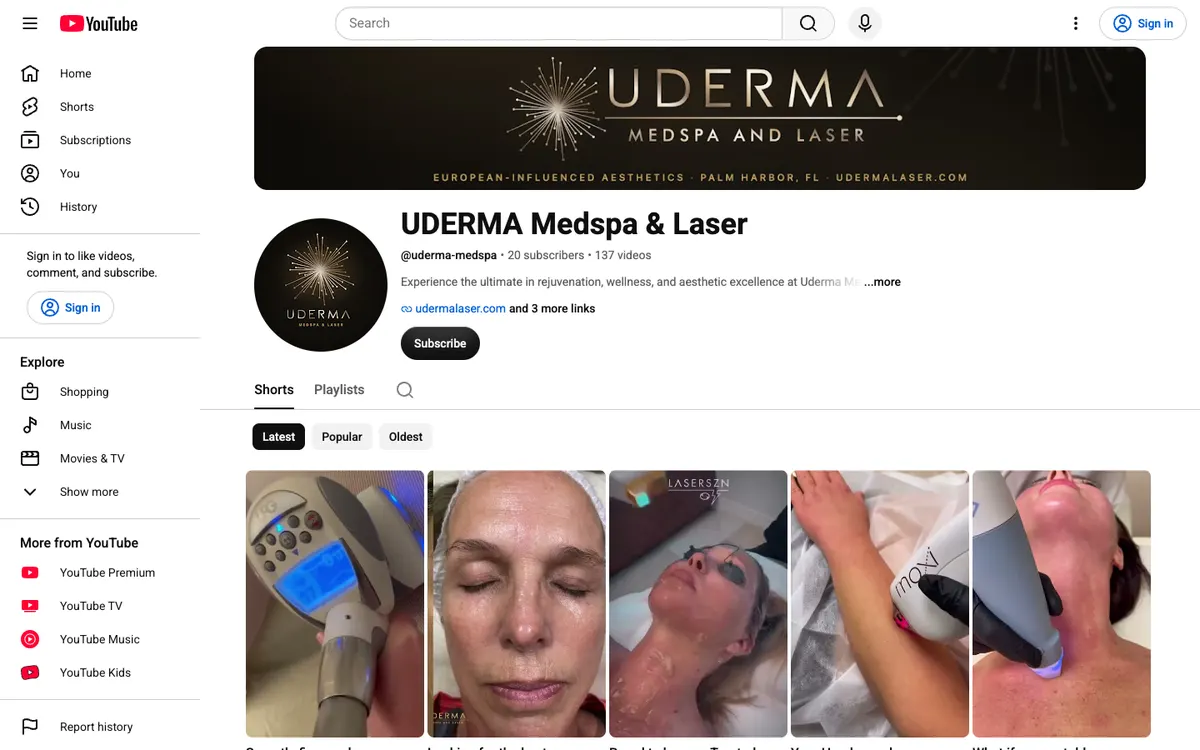
Overview
U Derma Medspa and Laser in Palm Harbor, Florida, has years of treatment videos on Instagram: short Reels of lasers, injectables and body contouring, each set to a music track from Instagram's library. This project gives those videos a second life on YouTube as Shorts that speak. The music is dropped, and in its place is a narration in a clone of the practice owner's own voice. The channel was created in August 2026 and holds 137 videos, every one of them narrated and captioned.
The music is the whole problem. Instagram's licence covers Instagram only: of the first 97 videos that went to YouTube with their original tracks, 8 had already drawn label claims and regional blocks. The same music makes the Reels hard to move at all, because the Instagram Graph API lists the clinic's posts but withholds the video file for any Reel with licensed audio, 61 of 63 when measured. And search engines index spoken words, not music. So the track is dropped rather than ducked under a voice, since mixing it in would keep the claim, and the narration becomes the only audio on the file.
The voice is an ElevenLabs Instant Voice Clone of the practice owner, and he made it knowingly: a written request explained what the recording was for, he read a supplied paragraph into his phone, and the clone was built from one clean 117-second take, fingerprinted first because re-sent takes are indistinguishable by eye. He approved it over two rounds of samples. It is a clone and it is labelled as one: every narrated upload carries YouTube's altered or synthetic content disclosure.
Scripts are held to a clinic's standard. The first 132 were drafted by Claude from the Instagram caption and the matching treatment page, under a prompt that allows only facts present in those sources and rules out prices, percentages, statistics, superlatives, staff names and promises about the person in the clip. A validator with hard and soft patterns enforces the same rules in code, a failing draft is parked for editing instead of being dropped, and the client reviewed the scripts before anything was rendered. For new posts the default path now uses no model at all: the clinic's current captions are long enough that the script is the caption itself, selected and cleaned, and the validator drops the offending sentence rather than the script.
The render follows the engineering proven on 22sGems and changes what a clinic's footage needs. Pace is corrected with ffmpeg's atempo after synthesis, because the v3 model ignores the speed setting, and the owner's feedback showed that what he hears is the stretch ratio rather than the words per minute. When the voice outlasts the footage the clip loops instead of freezing, since the median clip is 15 seconds against 25 to 40 seconds of speech and Reels are cut to loop. Landscape clips are reframed onto a vertical canvas with a blurred copy behind them, so that every render is a Short. Subtitles come from ElevenLabs' character timestamps, and the phonetic respellings that fix brand names for the engine are mapped back before a human reads anything.
Nothing publishes without the owner. New posts are imported by a Cloudflare Worker on a daily cron and land as pending in an admin tool behind Cloudflare Access; approving a video is the whole rule that queues it. From there three GitHub Actions workflows run unattended: one narrates new approvals, one uploads up to 12 videos a day into per-treatment playlists, and one replaces older uploads and settles what a quota stop left unfinished. The 97 videos that first went up with music were replaced one by one between 5 and 12 September 2026, and the old ones were made private rather than deleted, for the owner to remove himself. The Shorts then come back to the clinic's site: embedded on insight pages with a transcript and VideoObject markup, listed in the video sitemap, and linked as playlists from every treatment page.
What was built
- An Instagram importer on a Cloudflare Worker cron: posts listed through the Graph API, the video file fetched a second way when the API withholds it, watermarks and a five-day retry list in D1, and no row created for a post whose file could not be fetched.
- An approval gate: an admin tool behind Cloudflare Access where every new video lands as pending, and approved plus a video file is the single rule that queues it for narration and YouTube.
- A script pipeline with two paths and one validator: Claude drafting from the caption and the treatment page, or a mechanical builder that uses the clinic's own caption with no model, both checked against the same medical-claims rules.
- Medical-claims guardrails in code: hard and soft pattern lists for prices, statistics, superlatives, FDA and clinical claims, staff names and result promises, with failing drafts parked as needs-edit rather than dropped.
- Narration on an ElevenLabs Instant Voice Clone of the practice owner, through the REST API with character timestamps, with a pronunciation table for treatment and brand names chosen by ear.
- An ffmpeg render that maps only the new audio, corrects pace without shifting pitch, normalises loudness in two passes to -16 LUFS, loops short footage under long speech and reframes landscape clips into vertical Shorts.
- Subtitles from the character alignment as SRT for YouTube and WebVTT for the site's own players, with respelled brand names mapped back to their real spelling.
- A YouTube uploader on the Data API v3 written against the REST endpoints: OAuth, resumable upload, titles from the caption's first line, descriptions with links to the treatment page, the insight page and the consultation form, a results-vary disclaimer, tags and the synthetic-media disclosure.
- A local preflight that validates every title, description and tag for zero quota before the first upload of the day.
- One playlist per treatment, found or created and remembered in D1, with a debt table for playlist adds that failed and are retried nightly.
- A replacement procedure for the 97 uploads that carried Instagram music: upload unlisted, write the new id to D1 at once, wait for processing, make it public, move the playlist slot, make the old video private.
- A patient-privacy rule made structural: a before-and-after video is skipped unless explicitly allowed, and even then only when its narrated version exists, so the music version of a patient's photos can never reach the channel.
- The return path to the website: Shorts embedded through a click-to-load facade that makes no third-party request before the click, VideoObject markup with the transcript, a video sitemap and playlist links on every treatment page.
- A long-form pilot stitched from the same clips: a widescreen tour of 40 laser videos with a brand panel, chapters and crossfades, built on request and kept unlisted.
Stack
Pipeline
- Python, standard library only
- Narration, batch runner, uploader, replacement and tour tools; HTTP through urllib, no SDKs for ElevenLabs or Google.
- Node.js
- Script drafting and validation, the shared caption cleaner, and the export of the upload queue with titles, descriptions and tags.
- ffmpeg
- Audio replacement, atempo pace correction, two-pass loudnorm, looping, vertical reframing with a blurred background, H.264 and AAC encode; written for the intersection of ffmpeg 5.1 and 9.
AI
- ElevenLabs text to speech
- The eleven_v3 model through the with-timestamps endpoint; stability 0.5, similarity 0.8, style 0, with a credit cap set on the API key itself.
- ElevenLabs Instant Voice Clone
- The practice owner's voice from one clean 117-second take, prepared as mono 44.1 kHz with a high-pass and loudness normalisation and nothing else.
- Claude
- Drafted the first 132 scripts from caption and treatment-page copy under a cached compliance prompt; new posts default to the mechanical path with no model.
Platforms & APIs
- Instagram Graph API
- Read-only listing of the clinic's posts, captions, permalinks and thumbnails through Instagram Login.
- YouTube Data API v3
- videos.insert with resumable upload, videos.update for status and metadata, captions.insert, playlists and playlistItems, videos.list for file details.
Data
- Cloudflare D1
- The state of the whole pipeline: media items and files, decisions, publishes, runtime watermarks, playlists and playlist debts.
- Cloudflare R2
- Originals, derivatives and the render cache: mp3, alignment, script, subtitles and video per item, with the paid mp3 stored even when a later step fails.
Infrastructure & DevOps
- GitHub Actions
- Three scheduled workflows - narrate new approvals, the daily upload drip, the nightly replacement and repair pass - each exiting cleanly on a quota stop and failing loudly on anything else.
- Cloudflare Workers + cron triggers
- The admin tool, the Instagram importer and the auto-publish check, in the client's own Cloudflare account.
- Cloudflare Access
- Protects the admin tool, which fails closed because the archive contains patient before-and-after photos.
Frontend
- Astro on Cloudflare Pages
- The clinic's site: insight pages with the embedded Short, its transcript and VideoObject markup, the video library and the video sitemap.
Engineering highlights
The music that makes a Reel a problem on YouTube is also what makes it undownloadable: the Graph API withheld the file for 61 of 63 videos, all of them with licensed audio. The importer was designed around that measurement, runs entirely on Cloudflare's network with no container, and never holds a credential that could post as the clinic.
Compliance is a prompt and a validator, and the validator is the same on both script paths. It works per sentence, so one bad claim costs a sentence and not the video, and a caption with nothing usable leaves the item with no script at all, which holds it rather than inventing one. Stripping '#1' from a caption once turned a hashtag into a published claim; that line is now refused as a title and dropped from the voice.
Consent was treated as scoped. Permission to show a before-and-after on the clinic's own site is not permission to publish it on YouTube, and the consent later given for YouTube was conditional on the narrated version, so the eligibility check requires both flags together.
One clip at 720 by 710 pixels, ten pixels wider than tall, was classified as a regular video and rearranged the whole channel page around itself. The fix went in at four layers - render, cache, upload and a repair pass over what was already published, reading stored dimensions because the /shorts/ URL answers 200 for any video.
Two YouTube API behaviours decide whether the AI disclosure survives: videos.insert silently drops the synthetic-media flag, and videos.update replaces the whole status object, so the flag is re-asserted after every insert and on every change of privacy. Subtitles are attached in a separate pass, after 13 of 13 inline caption uploads failed right after upload and spent half a day's quota.
The upload id is written to D1 before playlists, captions or cleanup run, state files are written to a temporary name and renamed, failures are counted with first and last dates rather than overwritten, and a replaced video is made private and never deleted - the owner gets the list and removes them himself.