Haus of Brimstone
Shopify store for an Austin brand of handmade wearable horns, live since the summer of 2024 after the domain had sat on a Squarespace coming-soon page.
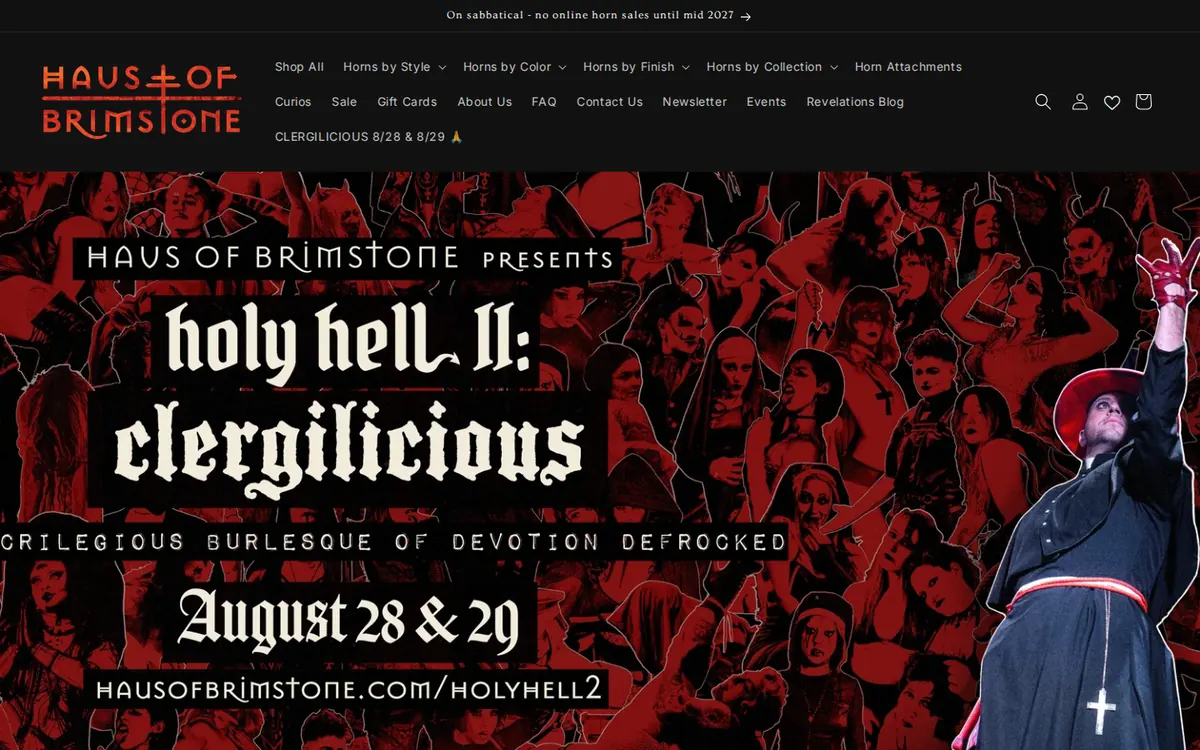
Overview
Haus of Brimstone is an Austin brand that makes wearable horns - handmade, sold by style, colour and finish, with attachments so they can be worn with any hair. The domain sat on a Squarespace coming-soon page with a newsletter form from 2022 until the middle of 2024; the shop itself launched on Shopify in the summer of 2024, and the archive still shows its 'under construction' banner in August that year.
The store is built around a merchandising taxonomy rather than a flat catalogue: 45 collections cut the same products by style (Imp, Incubus, Fiend, Tiefling, Azazel, Succubus, Sylvan Antlers), by colour, by finish (glitter, gloss, iridescent, matte, metallic, ombre) and by capsule collection, and a mega menu exposes all four cuts at once. Around it sit a wishlist, back-in-stock alerts, tabbed product information, gift cards, a blog and a newsletter, plus a how-to-wear guide for the four attachment options.
The same storefront also works as the box office for the brand's stage productions in Austin. Each show gets its own page, a printed-style programme page and an application page for performers, and its seats are sold as Shopify products in tiers - general admission, preferred seating, front row, then VIP lounge and black-box tables and couches by party size. Five productions have run through it since 2025. The horn catalogue is currently paused - the storefront carries an 'on sabbatical' notice with no online horn sales until mid-2027 - while ticket sales stay open.
What was built
- A Shopify store on the Dawn theme, in front of a catalogue of handmade wearable horns, attachments and curios.
- A 45-collection merchandising taxonomy: horns by style, by colour, by finish and by capsule collection, all reachable from one mega menu.
- Wishlists, back-in-stock alerts and tabbed product information through the app layer, so shoppers can follow made-to-order items that are not in stock.
- Event pages, programme pages and performer application pages for five stage productions, published as store pages.
- Ticketing as commerce: seats sold as products in tiers from general admission to VIP tables and couches, with party size carried in the variant.
- Supporting content: an about page, an FAQ, a how-to-wear guide for the four attachment types, a gallery, a newsletter page and the Revelations blog.
- Gift cards, a sale collection and a privacy control page for data-sharing opt-out.
- The storefront sits behind Cloudflare, and the theme has been kept current - Dawn 13 at launch, Dawn 15.4 today, the eleventh theme in the shop's history.
Stack
CMS & Commerce
- Shopify
- Storefront, catalogue, checkout, gift cards, pages and blog
- Dawn 15.4
- Shopify's reference theme, upgraded from Dawn 13 since launch
- Shopify collections and variants
- The style, colour, finish and collection taxonomy, and the ticket tiers
Integrations & Payments
- Advanced Wishlist
- Saved items with share and reminder options
- Restock Rocket
- Back-in-stock alerts for made-to-order and sold-out horns
- Qikify Smart Menu
- The mega menu that carries all four ways into the catalogue
- Tabs Studio
- Tabbed product information
Infrastructure & DevOps
- Cloudflare
- In front of the Shopify storefront on the live domain
- Squarespace (before)
- The coming-soon page with a newsletter form that held the domain until mid-2024
Engineering highlights
One catalogue, four ways in: the same horns are merchandised by style, colour, finish and capsule collection, so a shopper who arrives wanting 'something green' and one who arrives wanting 'Tiefling' both land on a real collection page.
The shop doubles as a box office: seats for five stage productions have been sold as ordinary Shopify products, with tiers and party sizes as variants, so ticketing needed no separate platform, payment flow or customer account.
Made-to-order is treated as a first-class state rather than an out-of-stock page, with back-in-stock alerts and wishlists doing the waiting.
The sabbatical is handled in the storefront itself: the catalogue is paused with a dated notice while event sales stay open, instead of taking the site down.