AdPal
AI chatbot and lifecycle-engagement platform for B2B SaaS and fintech: multi-tenant RAG over customer knowledge bases, OAuth-connected CRM and ad-platform pipelines.
Overview
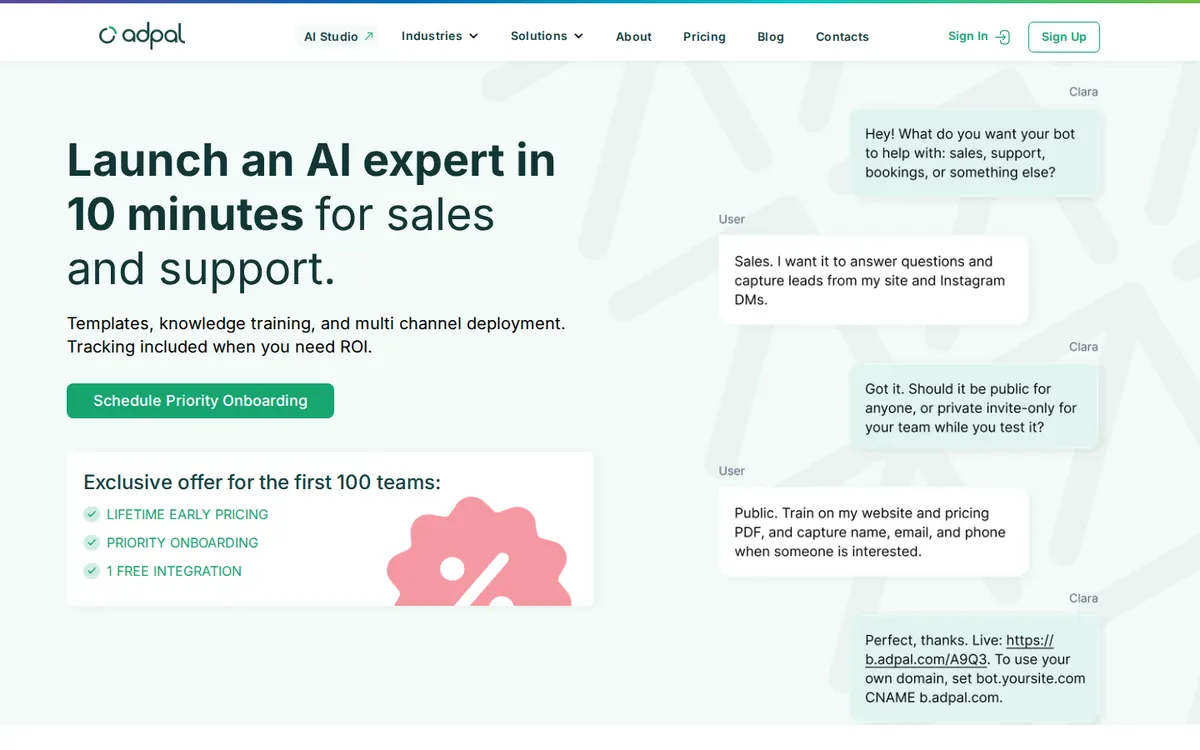
AdPal is an AI assistant and lead-intelligence platform for B2B SaaS, fintech and service businesses. Its assistant, Clara, is trained on a company's website, documents and files, adapts its answers to the page and campaign a visitor came from, qualifies the conversation and captures contact details. Qualified chats land in a unified inbox with the visitor's journey, UTM data and a short summary, so a sales team can see which channels bring real leads.
The first generation of the portal ran on Laravel 8 with an Angular 15 client and ClickHouse for analytics. At the end of 2023 the product moved to a single Next.js 14 codebase, which carried the main build through 2024 and 2025: the chatbot builder, retrieval over customer knowledge, messenger channels, attribution reports, billing and a public API. Around the portal sit a Shopify app, a standalone chat widget, an Expo mobile app and WordPress tracking plugins. Around that portal grew a set of services rather than one application: tracking, bots, retrieval, ad automation and the infrastructure to run them.
Tracking is its own stack, because attribution is only as good as the data under it: a browser SDK bundled for the page, an ingest API and a backend that writes events into ClickHouse through Kafka and Redis, with SQS for hand-off, MaxMind GeoIP for location and user-agent parsing for device. That is what makes the source, campaign, keyword and device reports in the portal answerable.
Retrieval moved into a dedicated Python service: FastAPI with Pydantic models, a Qdrant vector database, OpenAI embeddings with a local sentence-transformers fallback when the API is not the right answer, and a PDF parser on PyMuPDF that pulls images and tables out of documents rather than flattening them to text. Heavy work runs as a Lambda worker off an SQS queue, infrastructure comes up through AWS CDK, and the whole thing runs locally against LocalStack so a developer does not need a cloud account to work on it.
The channels are a NestJS service of their own - Telegram through Telegraf, WhatsApp Business, Slack events and web APIs, plus WebSockets for live chat - over Sequelize with MySQL and Postgres alongside ClickHouse. Ad automation sits on the backend monorepo: site audits with Lighthouse, Wappalyzer and metascraper, the Facebook Business SDK, and Python services for Facebook campaigns, Google Ads campaigns and products, and a Performance Max autopilot.
The platform side is deliberately boring in the right places and specific where it counts: Serverless Framework and AWS CDK for the services, MSK for Kafka, a ClickHouse cluster with its own autoscaling stack, and a Kubernetes layout running ClickHouse through its operator with Keeper alongside Redpanda for streaming. Fingerprinting and visitor identification have their own small services, and a SIP edge covers telephony.
AdPal combined multi-tenant retrieval, OAuth-connected ad and CRM data and ClickHouse event analytics in one product, and its architecture lessons went straight into AEO Content. The AdPal line also includes AdPal Support, an embeddable assistant for Electro-Mech product support that answers from manuals, website content and support knowledge using Claude, Voyage AI embeddings and Turbopuffer hybrid search.
What was built
- A chatbot builder with templates, a versioned system-prompt editor, access settings, feedback review and training from uploaded files, crawled web pages, Google Drive folders and images.
- Per-tenant retrieval: documents are parsed, embedded and stored in ClickHouse under the client's ID, and relevant chunks are ranked by vector distance before the model answers.
- Multichannel deployment of one trained assistant: a website widget plus Telegram, WhatsApp, Instagram and Facebook Messenger connections.
- Visitor tracking and attribution: sessions, traffic sources, UTM, keyword, ad group and campaign lead reports, device and hour matrices, and keyword alerts.
- Data connections: OAuth for Google Ads, Search Console and Drive, HubSpot sync of contacts, companies and deals, and an offline-conversion feed that sends qualified leads with their Google click IDs back to Google Ads.
- Team workspaces with companies, roles (admin, manager, member, viewer), invitations, Stripe subscriptions and a token-authenticated public API for chats and reports.
- An embedded Shopify app with a web pixel extension that reports storefront order conversions to AdPal.
- An Expo mobile app for iOS and Android, and the Clara chat widget built as a UMD bundle and served from S3 through CloudFront.
- A tracking stack of its own: a browser SDK, an ingest API and a backend writing events to ClickHouse through Kafka and Redis, with SQS hand-off, MaxMind GeoIP lookups and user-agent parsing.
- A Python retrieval service on FastAPI with a Qdrant vector database, OpenAI embeddings with a sentence-transformers fallback, and a PyMuPDF parser that extracts images and tables from PDFs.
- A Lambda worker behind an SQS queue for the heavy retrieval work, with LocalStack and docker-compose so the service runs end to end on a laptop.
- A NestJS channel service for Telegram, WhatsApp Business and Slack, with WebSockets for live conversations, over Sequelize with MySQL, Postgres and ClickHouse.
- Site auditing in the backend monorepo: Lighthouse runs, Wappalyzer technology detection and metascraper metadata extraction.
- Ad automation services in Python for Facebook campaigns, Google Ads campaigns and products, and a Performance Max autopilot, alongside the Facebook Business SDK on the Node side.
- Infrastructure as code for the data plane: MSK for Kafka, a separate CDK stack for the ClickHouse cluster with autoscaling, and Kubernetes manifests running ClickHouse through its operator with Keeper, next to Redpanda.
- Visitor identification and fingerprinting services, and a SIP edge for telephony.
- Editing and flow-building surfaces in the portal: TipTap and MDXEditor for content, CodeMirror for HTML and JSON, and a node graph on React Flow with automatic dagre layout for scenarios.
- Email and messaging templates through MJML with Handlebars, Mustache and Pug, sent through SES and nodemailer.
- Localization across the portal with i18next and its backends, phone and country handling included.
Stack
Frontend
- Next.js 14
- Main portal on the Pages Router: dashboards, bot builder, inbox, analytics, settings and API routes.
- Mantine
- Component library shared by the portal, the Shopify app and the Clara chat widget.
- Angular 15
- Client of the first-generation portal, before the move to a single Next.js codebase.
- Expo / React Native
- AdPal mobile app for iOS and Android with sign-in, tracked sites and page analytics screens.
- TipTap, MDXEditor, CodeMirror
- Content, markdown and code editing inside the portal
- React Flow + dagre
- Scenario and flow graphs with automatic layout
- react-grid-layout
- Draggable, resizable dashboard tiles
- react-hook-form + zod
- Forms and schema validation
- TanStack Query
- Server state, caching and refetching
- i18next
- Localization with chained http and local-storage backends
Backend
- Laravel 8 (PHP)
- First-generation REST API with HubSpot sync, LTV reports, webhooks and SQS messaging.
- Decorator-based controllers
- Portal API pattern with guard, role and HTTP-method decorators over server-side actions.
- Socket.IO
- Real-time channel between the portal server and connected browser clients.
- NestJS
- Channel service for Telegram, WhatsApp and Slack, and the CRM apps
- FastAPI (Python)
- Retrieval service with Pydantic models and a Lambda worker
- Express
- Tracking ingest API and tracking backend
- Serverless Framework
- Deployment of the backend monorepo, with Fargate, webpack, offline and monorepo plugins
Data
- ClickHouse
- Main store for visitor sessions, events, leads, integrations and chatbot embeddings, run as a replicated cluster.
- Kafka
- Asynchronous event stream for emails, webhooks and CRM synchronization.
- Redis
- Key-value store holding domain-keyed tracker data that the portal reads and updates.
- Supabase
- Postgres and Google sign-in for AdPal Support, plus lead tables for messenger bots in the portal.
- Qdrant
- Vector database behind the Python retrieval service
- MaxMind GeoIP2
- Location lookups on tracking events
- Sequelize (MySQL, Postgres)
- Relational storage behind the channel service
- Amazon SQS
- Queue between the API and the workers
AI
- Anthropic Claude
- Chat provider through the Anthropic API and AWS Bedrock, including Bedrock vision for image training data.
- OpenAI
- Alternative chat and embedding provider, routed alongside Claude by the portal's AI controller.
- LlamaIndex
- Workflow and OpenAI integration layer behind the retrieval-augmented chat provider.
- Voyage AI + Turbopuffer
- Embeddings and hybrid search over manuals and support knowledge in AdPal Support.
- AWS Bedrock
- Model access alongside the Anthropic and OpenAI SDKs
- sentence-transformers
- Local embedding fallback in the Python retrieval service
- PyMuPDF
- PDF parsing that keeps images and tables instead of flattening to text
Infrastructure & DevOps
- AWS CDK
- Infrastructure as code for the portal, the Shopify app and the chat widget.
- ECS Fargate
- Containerized portal services behind an Application Load Balancer with CPU-based autoscaling.
- AWS Lambda
- Generates per-company tracker script settings, invoked from the portal when a website is configured.
- S3 + CloudFront
- Static hosting and CDN delivery for the Clara chat widget bundle.
- Docker Compose
- Local stack with a ClickHouse cluster, ClickHouse Keeper nodes and Redis.
- Cloudflare Pages
- Hosting for the static adpal.com marketing site after its move off Webflow.
- Amazon MSK
- Managed Kafka for the event pipeline
- ClickHouse cluster (CDK)
- Its own infrastructure stack with autoscaling
- Kubernetes
- ClickHouse operator with Keeper, and Redpanda alongside it
- LocalStack
- The retrieval service runs end to end locally without a cloud account
- SIP edge
- Telephony infrastructure as its own CDK stack
Integrations & Payments
- Stripe
- Billing plans, subscriptions and payment webhooks for AdPal workspaces.
- HubSpot
- CRM sync of contacts, companies, deals, pipelines and associations from the platform.
- Google Ads, Search Console, Drive
- OAuth connections for campaign data, search queries, offline conversions and bot training files.
- Telegram, WhatsApp, Instagram, Messenger
- Messaging channels where the same trained assistant answers visitors and captures leads.
- AWS SES + MJML
- Transactional email built from MJML templates and sent through Amazon SES.
- Facebook Business SDK
- Campaign management on the ad side
- Slack (Web and Events APIs)
- Assistant and notifications inside Slack workspaces
- Lighthouse, Wappalyzer, metascraper
- Site audits: performance, detected technologies and page metadata
CMS & Commerce
- Shopify app
- Embedded Shopify app with a strict-sandbox web pixel extension that records order conversions.
- WordPress plugins
- Plugins that add AdPal traffic tracking and monitoring to WordPress sites.
Tooling & QA
- Vitest
- Unit tests for controllers and utilities in the Next.js portal.
- Playwright
- End-to-end browser tests for the AdPal Support assistant.
Engineering highlights
Storage was consolidated on ClickHouse: a short-lived Prisma and Postgres layer was replaced by a ClickHouse adapter in February 2024, so analytics, leads and chatbot embeddings share one columnar store queried with vector distance functions.
Campaign context flows into the conversation: UTM parameters reach the bot, so answers adapt to the campaign, keyword and page a visitor arrived from.
Attribution closes the loop with ad spend: contacts marked as quality leads keep their Google click ID and are exported as an offline-conversion feed for Google Ads.
The platform grew from a Laravel and Angular portal into one Next.js codebase, with the portal, the Shopify app and the chat widget each deployed as its own AWS CDK stack.
Retrieval earned its own runtime: the Python service with Qdrant, a PDF parser that keeps tables and images, and a queue-fed Lambda worker exists because document quality, not model choice, is what decides whether an assistant answers correctly.
The event pipeline is built like an analytics product rather than a feature: SDK, ingest API, Kafka, ClickHouse and GeoIP, which is why the portal can answer questions by campaign, keyword, device and hour instead of showing totals.